

Tooth decay is the most common health condition in the world. Not the flu. Not back pain. Dental decay quietly destroying teeth across every age group, every country, every income level. According to the World Health Organization’s Global Oral Health Status Report, untreated decay in permanent teeth currently affects 2.5 billion people globally. Another 514 million children are living with untreated decay in their baby teeth.
Those numbers are striking. But what makes tooth decay particularly frustrating is that it rarely announces itself early. By the time most people feel pain, the damage is already well underway.
This guide covers everything you need to know what tooth decay actually is, how a cavity forms, what the warning signs look like at each stage, how treatment works, and what you can do starting today to protect your teeth for the long term.
Tooth decay starts silently, pain is a late-stage symptom, not an early warning sign. The process is driven by bacteria that produce acid after feeding on sugar. Early-stage decay can be reversed without drilling. Once a cavity forms, professional treatment is needed. With the right care and the right dental team, most cases are very manageable.
What is tooth decay? And what exactly is a cavity?
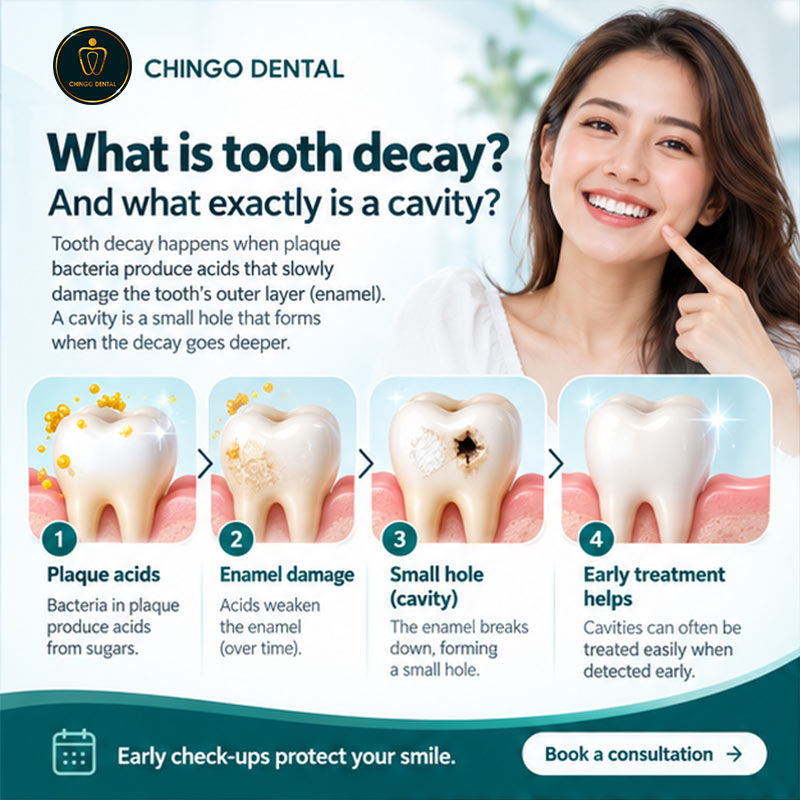
Tooth decay is a gradual process in which the hard outer surface of a tooth breaks down over time. It happens when acid produced by bacteria in the mouth repeatedly attacks the enamel until the structure weakens and eventually collapses inward.
The term “cavity” refers specifically to the hole that forms once decay has progressed far enough to create a visible pit or gap in the tooth surface. So tooth decay is the process, and a cavity is the result. The two are closely related, but they are not quite the same thing.
Both fall under a broader category of teeth diseases known as dental caries, the clinical term dentists use worldwide. You will often see “dental caries” and “tooth decay” used interchangeably in medical literature, because they describe the same condition.
Understanding this distinction matters because it changes how you think about timing. Tooth decay that is caught before a hole forms is far easier and far less expensive to treat than a cavity that has already taken shape.
What are the causes of tooth decay?
Most people know that sugar is somehow involved in tooth decay, but the actual mechanism is more specific than that and understanding it makes prevention a lot more intuitive.
Why bacteria are the root of the problem
Your mouth is home to hundreds of species of bacteria. Most are harmless or even beneficial. But one group primarily Streptococcus mutans is the main bacteria that causes tooth decay. These microorganisms live in a sticky film called plaque that constantly forms on the surface of teeth.
When you eat or drink anything containing sugar or refined carbohydrates, these bacteria feed on the fermentable sugars and produce acid as a byproduct. That acid is what causes tooth decay: it lowers the pH in your mouth to below 5.5, which is the threshold at which enamel begins to dissolve. This process is called demineralization.
Saliva helps by neutralizing acid and restoring minerals to the enamel surface, a process called remineralization. But when acid attacks happen more frequently than saliva can repair, the balance tips toward decay.
Which risk factors make tooth decay more likely?
Not everyone is equally susceptible. Some people brush infrequently and eat a lot of sugar but rarely get cavities. Others seem to develop tooth decay despite careful hygiene. Several factors influence how quickly decay takes hold.
Diet plays the biggest role, and the main cause of tooth decay is not just the total amount of sugar consumed, it is the frequency of exposure. Sipping on a sweetened coffee slowly over two hours creates a far longer acid attack than drinking the same amount quickly. Sticky foods that cling to the tooth surface are especially problematic because they keep bacteria fed for longer.
Dry mouth is another significant risk factor. Saliva is the mouth’s natural defense against acid. People who take certain medications, breathe through their mouth, or have conditions that reduce saliva flow lose that protective buffer and become significantly more vulnerable to tooth decay.
Deep grooves and pits in the back teeth are natural trap sites for food and bacteria. This is one reason why molars are where most cavities develop. For children, nighttime bottle feeding with milk or juice creates prolonged sugar exposure against teeth that have no opportunity to be rinsed by saliva a direct cause of tooth decay in children.
Insufficient fluoride exposure also increases risk. Fluoride helps enamel remineralize and makes the tooth surface more resistant to acid. People who drink non-fluoridated water and do not use fluoride toothpaste lose this important layer of protection.

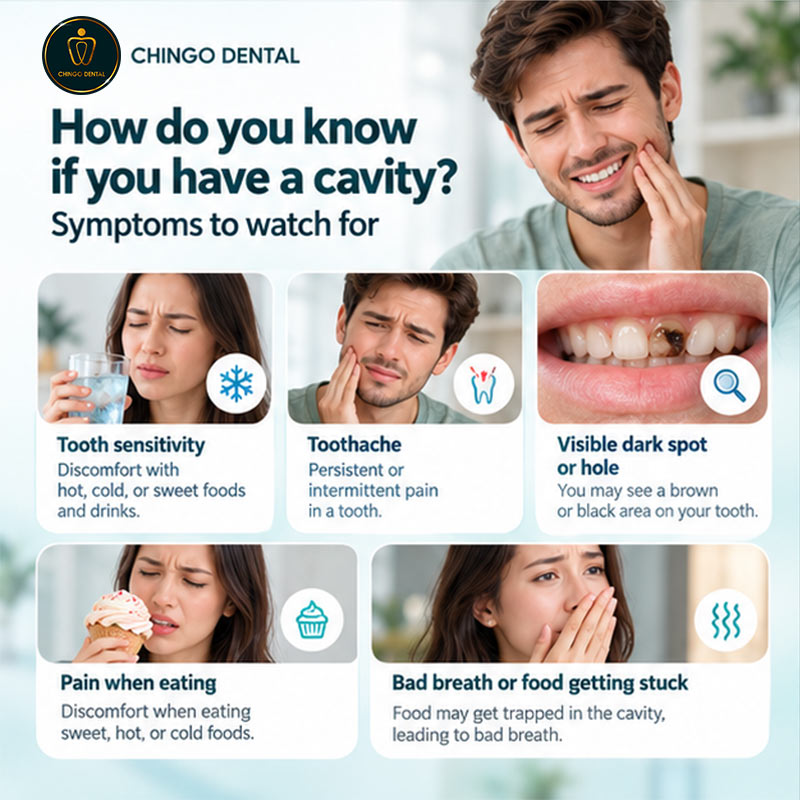
How do you know if you have a cavity? Symptoms to watch for
This is one of the most common questions patients ask and the honest answer is that early tooth decay rarely produces symptoms you can feel. Most cavities are identified by a dentist, not by the patient, precisely because the early stages are painless.
That said, there are signs to watch for at each stage of progression.
Early signs: before it becomes a cavity
The first visible sign of tooth decay is a chalky white spot on the enamel surface. This is where demineralization has begun to weaken the enamel from within. At this stage, you will not feel pain. You might notice that a small area of the tooth looks slightly different duller, less glossy, with a faintly rough texture.
Mild sensitivity to very cold or very sweet foods can appear at this point. It is easy to dismiss. Most people do.
Mid-stage signs: when decay is progressing
As enamel breaks down further, white spots darken to brown or black. The surface may feel rough when you run your tongue over it, what some people describe as scratches on teeth or a grainy texture that was not there before. Sensitivity becomes more noticeable, especially with cold drinks or sugary snacks.
Sore teeth when biting down is a sign that decay has likely reached the dentin, the softer layer beneath the enamel. Because dentin is less dense than enamel, tooth decay spreads faster once it crosses that threshold.
Advanced signs: when decay has gone deep
Once decay reaches the pulp the innermost layer of the tooth that contains nerves and blood vessels the symptoms become hard to ignore. A visible hole in the tooth, severe sensitivity that lingers after the trigger is removed, and sharp or throbbing pain that may come and go spontaneously are all indicators of advanced decay.
Persistent bad breath is another sign. Tooth decay bad breath comes specifically from the bacterial activity inside the cavity, the breakdown of organic matter by bacteria produces sulfur compounds that create a distinct and unpleasant odor. No amount of mouthwash resolves it if the underlying cavity is left untreated.
At this stage, people often ask: do cavities hurt? They can hurt intensely. But the absence of pain does not mean a cavity is not there. Pain is a late-stage symptom, which is exactly why routine check-ups matter even when you feel perfectly fine.
The 5 stages of tooth decay: what happens inside the tooth
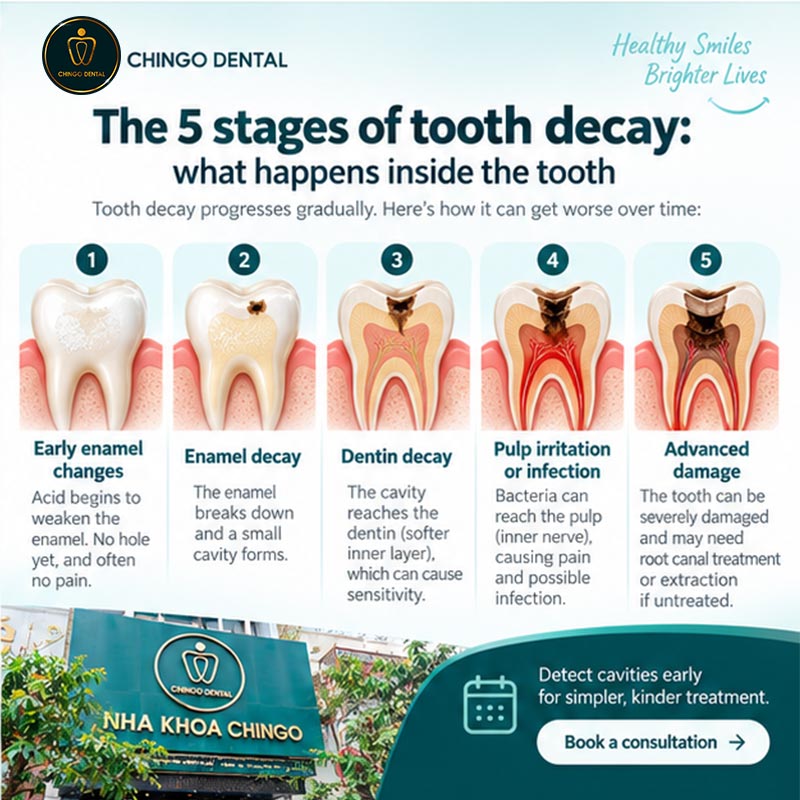
Tooth decay does not happen overnight. It follows a predictable progression, and understanding where you are in that progression is what determines which treatment options are available to you.
Stage 1 – Demineralization. Acid from bacteria begins to leach minerals from the enamel. White spot lesions appear on the tooth surface. The enamel is weakened but structurally intact. This is the only stage at which tooth decay can be fully reversed through fluoride remineralization therapy without any restorative intervention.
Stage 2 – Enamel Decay. The white spots break down further and turn brown. The enamel surface cracks and a small cavity forms. Once this happens, the damage is permanent and a dental filling is needed. There is usually no pain yet, which is why regular X-rays are essential for catching decay at this stage rather than the next.
Stage 3 – Dentin Decay. The decay crosses into the dentin layer, which is significantly softer than enamel. This means the cavity grows faster and wider. Sensitivity to temperature and sweets becomes pronounced. The tooth may ache when biting. A filling can still work here, though a larger restoration may be needed.
Stage 4 – Pulp Involvement. Bacteria reach the tooth’s inner pulp, which houses the nerve endings and blood vessels. Infection sets in. This is when spontaneous, throbbing pain typically begins the kind that wakes people up at night. Root canal treatment becomes necessary to remove the infected tissue and save the tooth.
Stage 5 – Abscess Formation. An abscess is a pocket of pus at the tip of the tooth root, formed when the infection spreads beyond the tooth itself into the surrounding bone. An untreated tooth abscess can lead to a life-threatening infection known as sepsis if left unaddressed. Severe jaw pain, swelling of the face or neck, and fever are all warning signs. At this point, extraction is often the only option, followed by implant or bridge replacement.
Tooth decay in children: why it deserves extra attention
For parents, tooth decay in children is a topic that is often underestimated. The prevailing belief that baby teeth “don’t matter because they fall out anyway” is one of the most damaging myths in pediatric dentistry.
Children’s enamel is thinner and softer than adult enamel, which means decay progresses faster and causes more damage in less time. According to the World Health Organization, the global prevalence of decay in children’s primary teeth is as high as 43%, making it a focal point of global oral health concerns.
Early Childhood Caries sometimes called baby bottle tooth decay is particularly common in toddlers and preschoolers. It develops when teeth are frequently exposed to sugary liquids, most often through prolonged bottle feeding with milk, formula, or juice. Falling asleep with a bottle is a major risk because saliva production drops during sleep, removing the natural acid-neutralizing buffer.
The consequences extend beyond the baby teeth themselves. Premature tooth loss in early childhood can affect speech development, create spacing problems for the permanent teeth, and cause pain that interferes with eating and concentration at school. Child rotten teeth are not just a cosmetic issue, they are a quality-of-life issue that parents should take seriously.
Dentists generally recommend that a child’s first dental visit should happen by the time they turn one or when the first tooth appears, whichever comes first. This early visit is not about drilling or procedures. It is about establishing a relationship with the dentist, reviewing feeding habits, and catching any early signs of decay before they become a bigger problem.
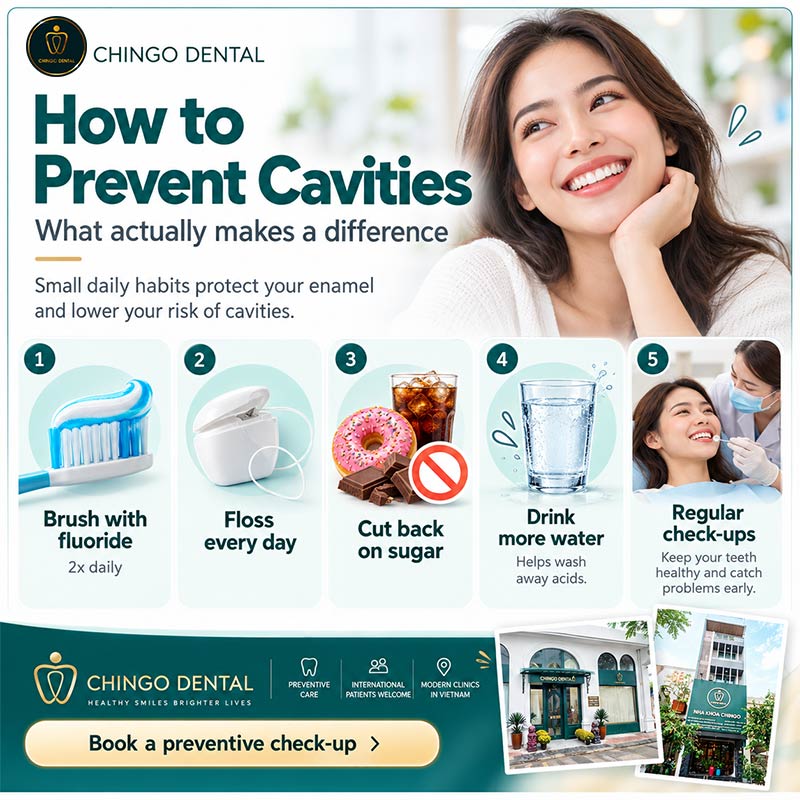
How to prevent cavities: what actually makes a difference
Knowing how to avoid cavities is not complicated in theory. The challenge is consistency and understanding which habits move the needle most.
Build a solid daily routine
The foundation of knowing how to prevent cavities is brushing twice a day with fluoride toothpaste. Technique matters as much as frequency. Spend at least two minutes covering all surfaces, and pay extra attention to the gumline and back teeth where plaque tends to accumulate.
Flossing once a day removes plaque from between teeth a space that a toothbrush cannot reach. Approximately one-third of each tooth’s surface sits between teeth. Skipping floss means leaving a significant portion of each tooth unprotected every single day.
Think about frequency, not just quantity
When it comes to diet, frequency of sugar exposure matters more than the total amount consumed. Every time you eat something containing sugar or starch, your mouth undergoes an acid attack that lasts approximately 20 minutes. Snacking frequently throughout the day means your mouth is in a near-constant state of acid exposure.
Drinking water particularly fluoridated water as your main beverage helps neutralize acid after meals. Rinsing your mouth with water immediately after eating is a simple habit that makes a real difference over time.
What your dentist can do that you cannot
Knowing how to remove tooth decay once it has started is not something you can manage at home but catching it before it develops is possible with professional support. Dental sealants thin coatings applied to the grooves of back teeth, physically block bacteria and food debris from settling into the pits where most cavities form. They are particularly effective for children but can be used for adults as well.
Professional fluoride treatments deliver a higher concentration of fluoride than toothpaste, and they take effect quickly. Combined with routine scaling and check-ups every six months, these treatments allow your dentist to catch the earliest signs of enamel demineralization before they develop into actual cavities.
For patients seeking quality dentistry in Hanoi, Chingo Dental’s preventive care program includes professional scaling, fluoride application, and early decay screening using digital X-ray imaging giving you a complete picture of your oral health at every visit.
Tooth decay treatment: what options are available?
Tooth cavity treatment depends almost entirely on the stage at which decay is caught. There is no universal answer the right approach is matched to the extent of the damage.
Fluoride therapy is the appropriate tooth decay treatment at Stage 1. When decay is caught at the demineralization stage before a physical hole has formed no drilling is needed. Professional fluoride application in a clinical setting delivers a high concentration of fluoride directly to the affected area, triggering remineralization of the weakened enamel. At home, fluoride toothpaste maintains that progress between visits.
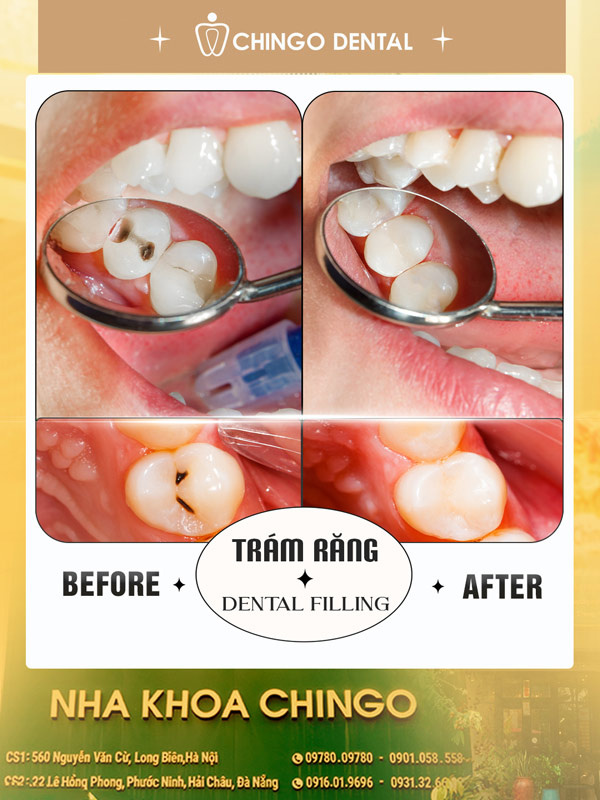
Dental fillings are the standard approach for Stage 2 and Stage 3 tooth decay. The dentist removes the decayed tissue, cleans and shapes the cavity, and fills it with a restorative material. Composite resin tooth-colored filling material is the most widely used option today because it bonds directly to the tooth structure and blends naturally with the surrounding teeth. At Chingo Dental, composite fillings are shaped and polished with careful attention to aesthetics, an approach that reflects the broader commitment to cosmetic dentistry that guides care across both clinic locations.
Inlay and onlay restorations are the right fit for cavities that are too large for a conventional filling but have not yet compromised the entire tooth. These are custom-made restorations fabricated using CAD/CAM digital technology, which allows for a precision fit and a rapid turnaround. Chingo Dental’s digital workflow supports same-session or next-visit restorations with a finish that is difficult to achieve with handmade methods.
Dental crowns become the appropriate solution when decay has weakened the tooth’s overall structure to the point where a filling or inlay cannot adequately support it. A crown is a full cap placed over the entire tooth. Chingo Dental offers Zirconia and E.max crowns, both known for their durability and natural translucency, materials that closely mimic the appearance of natural enamel while providing the structural support needed for long-term function.
Root canal treatment is required when infection has reached the pulp at Stage 4. The procedure removes infected tissue from inside the tooth, disinfects the canals, and seals them. Modern root canal procedures are performed under local anesthesia and are no more uncomfortable than a routine filling. The lingering reputation for pain is largely outdated, the procedure eliminates pain rather than creates it. A crown is typically placed over the tooth afterward to restore its strength.
Tooth extraction followed by implant replacement becomes necessary in Stage 5 cases where decay has destroyed too much structure to salvage. Dental implants titanium posts placed in the jawbone provide a permanent replacement that looks, feels, and functions like a natural tooth. Chingo Dental’s implant procedures are guided by Cone Beam CT (3D) imaging, which maps the exact anatomy of the jawbone before surgery and significantly improves placement precision and safety. For patients exploring dentistry in Da Nang, Chingo Dental’s clinic offers the full range of implant services from initial CT scanning through final crown placement with English-speaking staff and transparent pricing at every stage.
What happens when tooth decay is left untreated?
Some people know they have a cavity and delay treatment often because of time, cost concerns, or the absence of pain. Understanding what that delay actually costs is important.
Untreated tooth decay progresses predictably. A filling that would have cost a fraction of the price becomes a root canal. A root canal that could have saved the tooth becomes an extraction. And tooth loss, particularly in the back of the mouth where it is less visible, is rarely the end of the consequences.
When a tooth is lost, the surrounding teeth begin to drift into the gap over time. The jawbone at the extraction site begins to shrink because it no longer receives the stimulation it needs from the tooth root. Bite alignment shifts. Adjacent teeth bear additional load and become more vulnerable to further damage.
Tooth decay bad breath persists as a constant quality-of-life issue for as long as an active cavity remains. The bacterial environment inside an open cavity continuously produces sulfur compounds, and no oral hygiene routine can fully mask the odor while the source remains present.
There is also a well-documented systemic dimension to oral health. Research links chronic oral bacterial infection to elevated inflammatory markers associated with cardiovascular disease. WHO estimates that oral diseases account for over 20 million disability-adjusted life years annually, making them one of the top contributors to the global disease burden. The mouth is not separate from the rest of the body, what happens there influences what happens throughout it.
When should you actually see a dentist?
The clearest guidance is this: twice a year for a routine check-up, regardless of symptoms. Most cavities are completely painless in their early stages and are only identified through X-rays or a clinical examination.
There are also situations that warrant a prompt appointment within a day or two: a visible hole or pit in the tooth, sensitivity that lingers for more than a few seconds after a temperature trigger, a toothache that comes and goes, or an area that feels rough to the tongue.
And there are situations that require urgent, same-day care: severe spontaneous tooth pain, swelling of the face, cheek, or jaw, fever alongside tooth pain, or pus around the gumline. These signs can indicate an abscess that is spreading beyond the tooth and should never be waited out.
Chingo Dental’s clinics in Hanoi and Da Nang are equipped to handle the full spectrum from routine check-ups and preventive care through to emergency treatment and complex restorative cases. The team includes English-speaking dentists experienced in working with international patients, expats, and families living in or visiting Vietnam. For anyone seeking cosmetic dentistry alongside restorative care, the same clinical team handles both with a consultation process that begins by understanding your goals before recommending any treatment.
FAQ: Tooth decay & cavities
Question 1. What is the main cause of tooth decay?
The main cause of tooth decay is the acid produced when bacteria in the mouth primarily Streptococcus mutans feed on sugars and carbohydrates. That acid gradually dissolves the enamel, creating a cavity over time. Poor oral hygiene allows plaque to accumulate, which gives those bacteria a protected environment to work from continuously.
Question 2. Do cavities hurt?
Early cavities typically cause no pain at all. Discomfort appears when decay reaches the dentin and becomes more pronounced once the pulp is involved. Waiting for pain before seeking treatment means the cavity has already progressed significantly and will require a more involved procedure to address.
Question 3. How do I tell if I have a cavity without going to a dentist?
Visible signs include dark spots on the tooth, a rough patch you can feel with your tongue, or a hole in the tooth surface. Sensitivity to cold, sweets, or pressure when biting can also be a signal. However, many cavities produce none of these signs until they have reached a mid or advanced stage. The only reliable way to detect early tooth decay is through a dental X-ray.
Question 4. Can tooth decay be reversed?
Only at Stage 1 before a hole has formed, can decay be reversed through fluoride remineralization. Once a cavity exists, the damaged enamel does not regenerate. Professional treatment is required to remove the decay and restore the tooth’s structure.
Question 5. How quickly does tooth decay progress?
The timeline varies by diet, saliva flow, and individual tooth structure. Under poor conditions, enamel demineralization can progress into a full cavity within a few months. Under good conditions and with regular fluoride exposure, early-stage decay can remain stable for considerably longer.
Question 6. Is tooth decay dangerous for children even if it is just baby teeth?
Decay in baby teeth can cause significant pain, interfere with eating and speech development, and lead to early tooth loss that disrupts the alignment of permanent teeth. Children’s enamel is also thinner than adult enamel, meaning tooth decay in children spreads faster and reaches the nerve more quickly than it would in an adult.
Question 7. What is the connection between tooth decay and bad breath?
An active cavity harbors bacteria that break down organic matter and produce volatile sulfur compounds. These compounds are the direct cause of tooth decay bad breath. The odor persists regardless of brushing or mouthwash until the underlying decay is treated and the bacterial source is removed.
Protecting your teeth starts with a single decision
Tooth decay is not inevitable. It is a process driven by specific, identifiable factors bacteria, acid, sugar, time and it responds reliably to prevention and early intervention. The people who lose teeth to advanced decay are not usually people who neglected their health carelessly. They are often people who waited too long between visits, dismissed early symptoms, or simply did not have access to clear information about what was happening inside their own mouth.
You now have that information.
Whether you are dealing with a suspected cavity, managing a dental condition that has been put off, or simply overdue for a check-up, the team at Chingo Dental is ready to help. With clinics in Hanoi and Da Nang, English-speaking dentists, Cone Beam CT imaging, same-week appointments, and a commitment to transparent pricing this is a place where you get an honest assessment and a clear treatment plan without surprises.
Book your appointment with Chingo Dental today. A healthy smile is built one decision at a time, and this is a good one to make.
Contact Information – Chingo Dental International Cosmetic Dentistry
Chingo Hanoi Branch:
- Address: No. 1, Lane 558 Nguyen Van Cu Street, Bo De Ward, Hanoi City
- Hotline: 0915.217.855 – 0912.391.909 – 0978.090.780
Chingo Da Nang Branch:
- Address: No. 22 Le Hong Phong Street, Hai Chau Ward, Da Nang City Da Nang
- Hotline: 0916.019.696 – 0919.590.326 – 0916.102.552
Opening hours: 8:00 AM – 18:00 PM, all days of the week
Email: info@chingodental.vn
Website: https://chingodental.vn
This article is intended for informational purposes. Individual treatment plans and costs vary based on clinical assessment. Consult a qualified dental professional before making any treatment decisions.