Dental treatment in Vietnam costs 50 – 80% less than in the US, UK, or Australia without sacrificing quality.
Top clinics use internationally certified materials and technology on par with Western standards.
With the right planning, you can complete most treatments in 5 – 10 days and still have time to explore the country.
Every year, thousands of people fly across the world to fix their teeth. Dental travel to Vietnam has become one of the fastest-growing trends in medical tourism across Southeast Asia and dental travel Vietnam-bound patients now number in the tens of thousands annually. Not because they can’t find a dentist at home but because the price difference is simply too large to ignore. A single dental implant that costs $4,000 in the United States can run as little as $800 in Vietnam. A full set of porcelain veneers that would exceed $20,000 in London? You might pay $4,000 – $6,000 here, at a clinic equipped with the same European-grade materials.
Vietnam dental tourism has grown steadily over the past decade. Dentistry in Vietnam has transformed from a local service into an internationally recognized field, and the country is now one of the most searched dental travel destinations in Southeast Asia. Patients from Australia, the UK, the United States, and across Europe are booking flights not just for the savings but because they have seen results that speak for themselves.
This guide covers everything you need to know before making the trip: what dental work in Vietnam actually costs, whether it is safe, how to choose the right clinic, and how to plan your trip so the experience is smooth from the moment you land.
Why are so many people choosing dental tourism in vietnam?
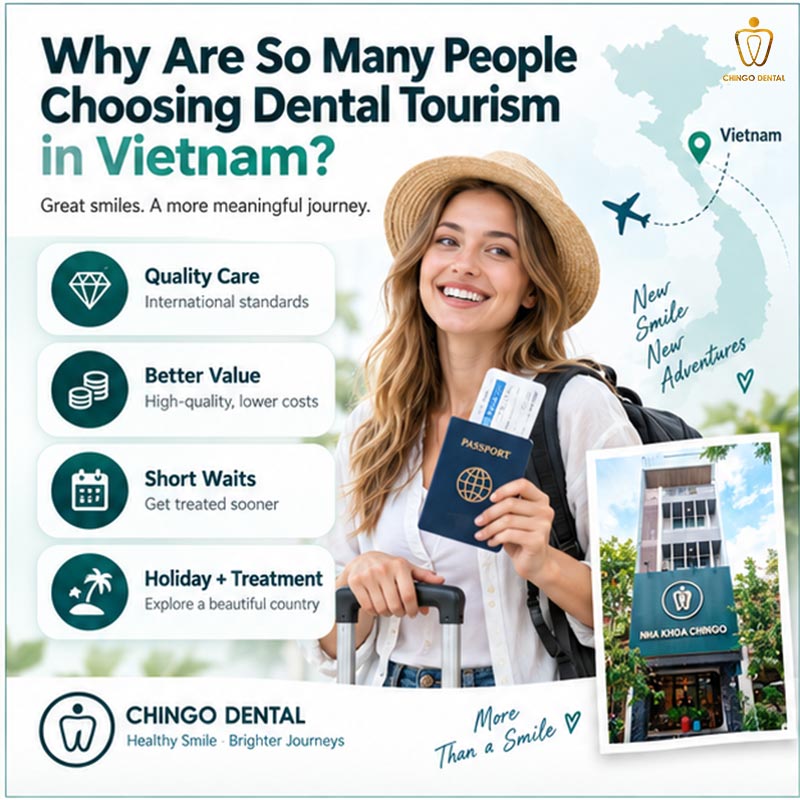
The short answer is value specifically, affordable dental care Vietnam has made possible without compromising standards. The country offers a rare combination of significantly lower costs and genuinely high-quality treatment. But that word can feel vague, so let’s be specific.
In countries like the US, Australia, and the UK, dental costs are driven up by high overheads rent, malpractice insurance, administrative staffing, and the cost of running a practice in a high-wage economy. In Vietnam, those overheads are significantly lower. That saving is passed directly to the patient. The materials, however, are often identical. Zirconia crowns from Germany, Emax veneers from Ivoclar, implant fixtures from Nobel Biocare or Osstem these are the same products used in Western clinics, sourced from the same manufacturers.
Beyond cost, there is another reason dental travel to Vietnam has become so popular: the country has invested heavily in modern dental technology. CT Cone Beam 3D scanners, CAD/CAM same-day crown milling, and Digital Smile Design software are no longer rare in Vietnamese dental clinics. They are standard at any reputable practice catering to international patients.
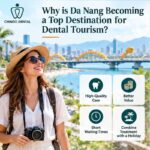
And then there is the experience itself. Vietnam is one of the most rewarding travel destinations in Asia. Whether you are spending a week in Hanoi’s Old Quarter, relaxing on the beaches of Da Nang, or exploring the ancient streets of Hoi An, a dental trip to Vietnam doubles as a genuinely memorable holiday. That combination serious dental care paired with real travel is exactly why the terms “dental holiday Vietnam” and “Vietnam dental holiday” have become part of how people describe the experience.
How much does dental treatment in vietnam actually cost?
Understanding dental tourism Vietnam cost is the first practical step for most patients. And dental treatment cost Vietnam varies more than people expect not because of inconsistent quality, but because treatment scope, materials, and clinic tier all play a role.
This is usually the first question. And the honest answer is: it depends on what you need and where you go. But to give you a real benchmark, here is how Vietnamese dental prices compare to what you would typically pay at home.
Treatment
Vietnam (USD)
USA (USD)
UK (GBP)
Australia (AUD)
Single Dental Implant
$700 – $1,200
$3,000 – $5,000
£2,500 – £4,000
A$4,000 – A$6,500
Zirconia Crown
$150 – $350
$1,200 – $2,000
£800 – £1,500
A$1,500 – A$2,500
Emax Veneer
$200 – $400
$1,500 – $2,500
£700 – £1,200
A$1,200 – A$2,000
Teeth Whitening
$80 – $200
$500 – $1,000
£300 – £700
A$500 – A$1,000
Root Canal + Crown
$200 – $450
$1,500 – $3,000
£1,000 – £2,000
A$1,500 – A$3,000
Full Mouth Rehabilitation
$4,000 – $10,000
$25,000 – $50,000+
£18,000+
A$28,000+
Vietnam dental prices reflect the country’s lower cost of living and operating expenses not a compromise on materials or technique. Prices are indicative ranges. Costs vary by clinic, material grade, and case complexity. Always request an itemized quote before committing.
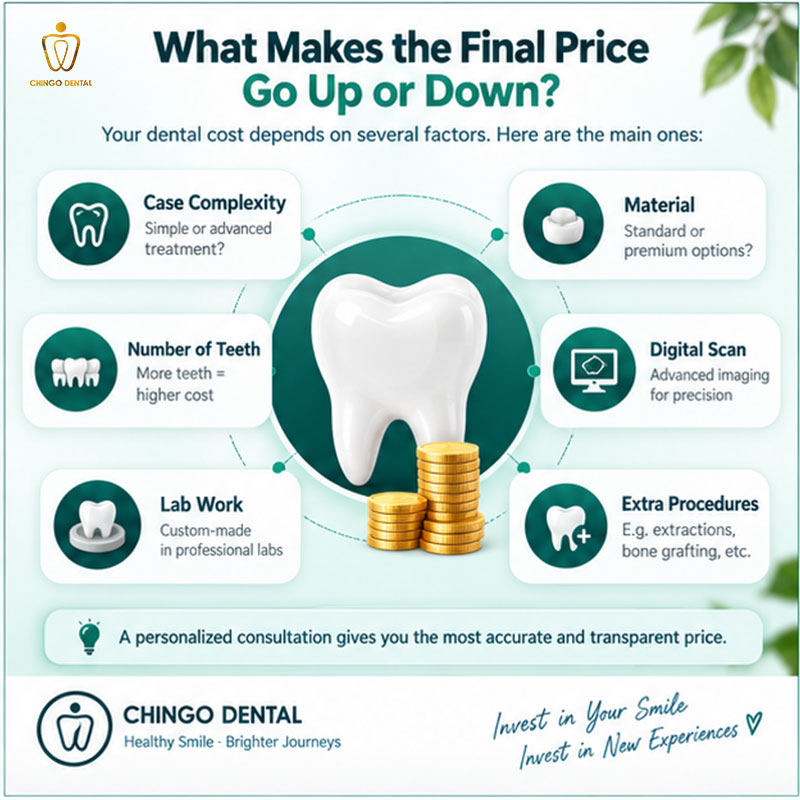
What makes the final price go up or down?
Three factors move the number more than anything else. The first is materials. A metal-ceramic crown and a full-zirconia crown are not the same product they look different, feel different, and last differently. Clinics that use premium materials like Emax or high-grade Zirconia will charge more, and for good reason.
The second factor is complexity. Extracting a tooth before placing an implant, adding bone grafting, or treating gum disease before cosmetic work all add time and cost. A straightforward single implant on a healthy jaw is very different from a full mouth rehabilitation that involves multiple extractions, bone augmentation, and 10 – 14 porcelain crowns.
The third factor is location. Clinics in central Hanoi or downtown Da Nang serving a high volume of foreign patients tend to price slightly higher than local clinics not because they are overcharging, but because they invest more in English-speaking staff, advanced equipment, and the kind of patient care that international visitors expect.
Transparent pricing matters enormously here. Reputable clinics provide written treatment plans with itemized costs before you agree to anything. If a clinic gives you a vague quote or cannot explain what is included, that is a sign to look elsewhere.
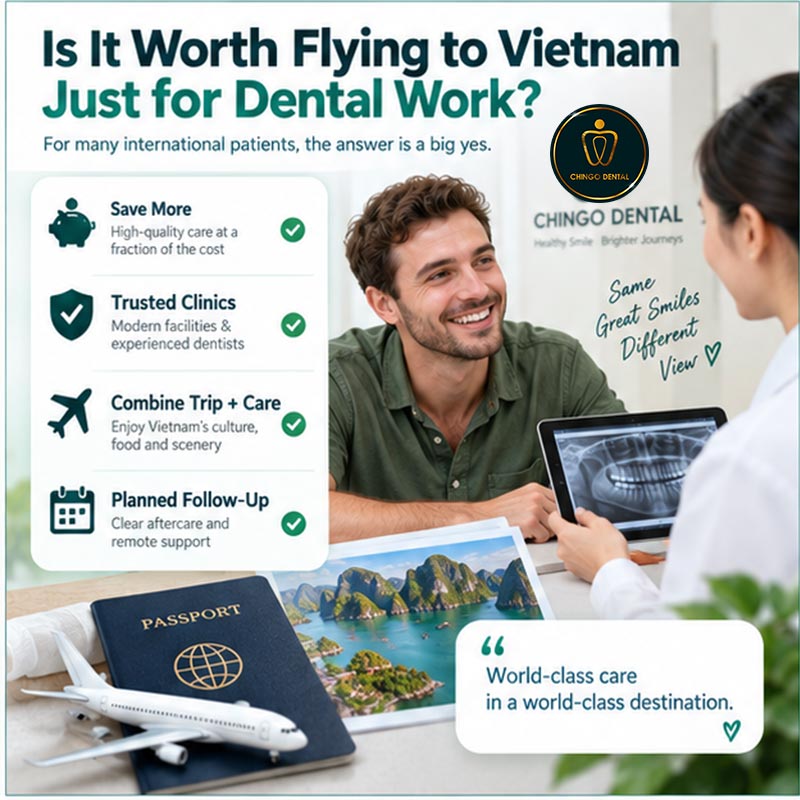
Is it worth flying to vietnam just for dental work?
Run the numbers honestly. A return flight from Australia to Da Nang might cost $600 – $900. A week in a comfortable hotel in Da Nang runs $50 – $100 per night. Add meals and transfers, and your total trip cost outside of dental treatment might be $1,500 – $2,000.
If your implant saves you $3,000 – $4,000 compared to what you would pay at home and that is a conservative estimate the trip pays for itself and still leaves you ahead. For patients needing multiple implants or a full smile makeover, the savings can reach $15,000 – $30,000. That changes the calculation entirely.
Is dental tourism in vietnam safe?
This is the question that matters most, and it deserves a direct answer.
Dental work in Vietnam is safe when you choose a licensed, well-equipped clinic with verifiable credentials and strong patient reviews. That condition is not unique to Vietnam it applies everywhere. The difference is that in Vietnam, you are doing the vetting remotely, without the ability to walk in and look around first. That is why knowing what to look for matters so much.
What standards do vietnamese dental clinics follow?
Finding a trustworthy dentist in Vietnam for foreigners starts with understanding the regulatory landscape. All dental clinics operating in Vietnam require licensing from the Ministry of Health. Any reputable dental clinic Vietnam for foreigners should be able to provide its license number on request. The right dental clinic in Vietnam for foreigners is one that looks beyond price to deliver credentials, technology, and genuine communication quality. Dentists must hold accredited qualifications, and many practicing at international-level clinics hold postgraduate degrees or specialist training from France, Japan, South Korea, or the United States. Sterilization protocols at reputable practices follow ISO standards, and materials sourced from European or American manufacturers come with traceability documentation.
The materials question comes up often, and understandably so. The short version: yes, the same implant brands used in Western clinics are available in Vietnam. Nobel Biocare, Straumann, Osstem, and Dentium are all in active use at established Vietnamese clinics. Emax and Zirconia ceramic systems from Ivoclar are standard at any clinic serving cosmetic dentistry patients. You are not getting a local imitation you are getting the same product at a fraction of the labor and overhead cost.
How do you know if a clinic is trustworthy?
Experience from the dental tourism community points to a consistent set of markers. Look for a clinic that publishes its dentists’ qualifications and training history, not just their names and photos. Look for a portfolio of before-and-after cases, ideally with patient consent notes visible. Read Google Maps reviews and Facebook reviews from verifiable accounts, not just testimonials curated on the clinic’s own website.
Ask directly what implant brands do you use? What ceramic system do you use for veneers and crowns? What warranty do you provide, and how are post-treatment issues handled remotely after I return home? A clinic that answers these questions clearly and without hesitation is operating in good faith. One that deflects or gives generic answers is not.
Finding an English speaking dentist Vietnam-side is not just a convenience it is a safety signal. If a clinic cannot communicate clearly about your treatment plan, the risks of misunderstanding are real. Clinics catering seriously to foreign patients invest in bilingual staff precisely because clear communication is part of the standard of care.
What do patients who have done it actually say?
Dental tourism Vietnam reviews paint a consistent picture when it comes to experiences at established clinics. Patients frequently report being surprised by how modern the facilities are. They note that the consultation process was more thorough than what they experienced at home. Many remark that the dentist took more time to explain the treatment plan than they expected.
Negative reviews, when they appear, tend to share a common thread patients went to the cheapest option they could find online, without doing proper research. This is not a Vietnam-specific problem. It is what happens anywhere in the world when price is the only criterion.
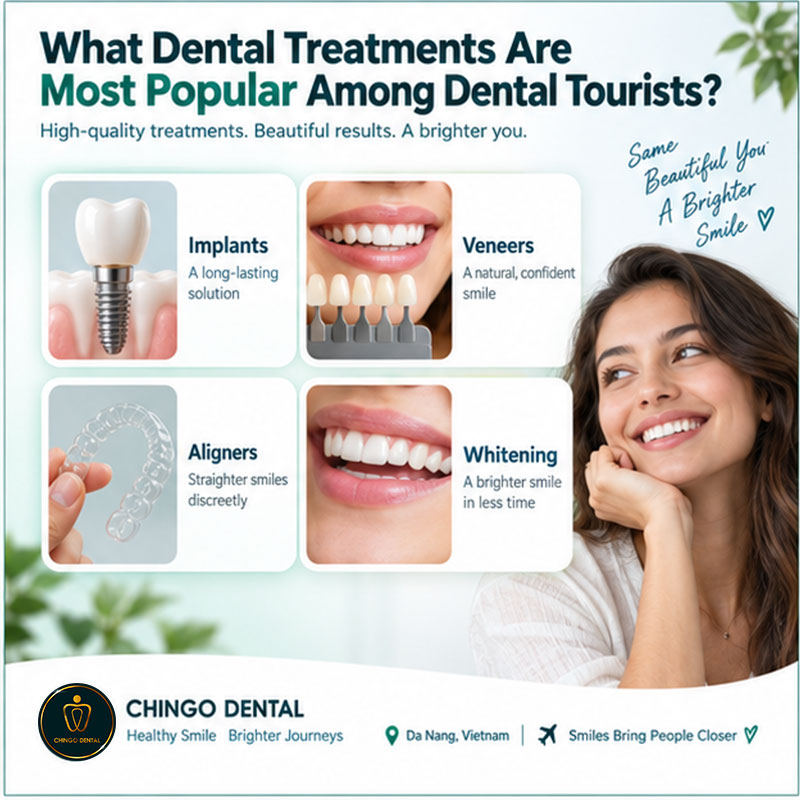
What dental treatments are most popular among dental tourists?
Dental Implants
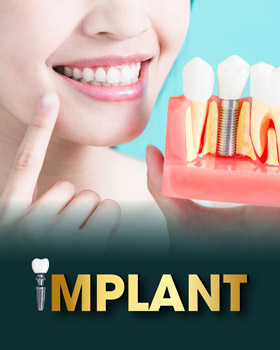
Implants represent the single largest financial saving for dental tourists. The cost gap between Vietnam and English-speaking countries is wide enough that even patients needing just one implant often find the trip worthwhile. Patients needing All-on-4 or All-on-6 full-arch solutions can save $15,000 – $30,000 compared to equivalent work in Australia or the US.
The technology used for implant planning matters. CT Cone Beam 3D imaging allows the dentist to assess bone density, identify nerve positions, and plan implant placement with precision before making a single incision. This is the standard of care at top-tier clinics, and it should be something you ask about specifically.
Porcelain Veneers and Smile Makeovers
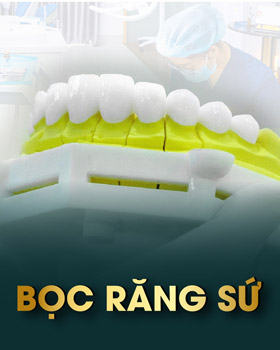
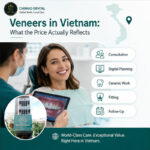
Vietnam has become a recognized destination for cosmetic dentistry, and veneers are a significant part of that. International patients often come specifically for a full smile transformation 8, 10, or 12 veneers placed over a single trip, using premium Emax or Zirconia ceramic.
The technology that has changed this experience most is Digital Smile Design. Using high-resolution photos and digital modeling, the dentist creates a visual preview of what your smile will look like before any preparation work begins. You can request adjustments shape, shade, proportion and only proceed once you are satisfied with the design. This removes much of the uncertainty that used to make smile makeovers feel like a leap of faith.
Porcelain Crowns
Crown work is well-suited to a dental tourism trip because treatment can often be completed within 5 – 7 days using CAD/CAM technology. Rather than waiting two weeks for a lab-produced crown, same-day or next-day milling means you can have your crown placed and verified before you leave the country. For multiple crowns, this technology is especially valuable.
Teeth Whitening and General Cosmetic Work
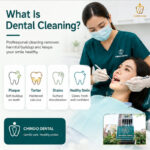
For patients whose needs are less extensive, professional whitening, composite bonding, or a single crown can be completed in as little as one to two days. Many patients fold this into a longer Vietnam holiday rather than planning a dedicated dental trip.
Full mouth rehabilitation
This is where Vietnam’s cost advantage is most dramatic. Full mouth rehabilitation involving multiple extractions, implants, bone grafting, and a complete set of porcelain crowns can cost $25,000 – $50,000 or more in the United States. In Vietnam, the same scope of work typically falls in the $5,000–$12,000 range, depending on the number of implants, materials chosen, and case complexity. For patients facing this level of treatment, the savings alone make the flight an obvious decision.
How do you choose the best dental clinic in Vietnam?
What should you look for in an international dental clinic in Vietnam?
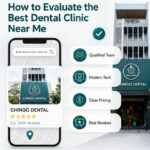
Choosing an international dental clinic Vietnam-based patients trust comes down to a few consistent factors.
Start with licensing. Every reputable clinic should be able to provide its Ministry of Health registration number. From there, look at the dentists’ credentials where they trained, what specialist qualifications they hold, and whether they have experience specifically with foreign patients.
Technology is the next checkpoint. A clinic investing in CT Cone Beam 3D, CAD/CAM milling, and Digital Smile Design is demonstrating a commitment to precision that goes beyond basic dentistry. These are not luxury extras they are tools that improve outcomes.
Reviews matter, but context matters more. A clinic with 4.8 stars and 300 reviews is more informative than one with 5 stars and 12 reviews. Look for reviews that mention specific treatments, describe the consultation process, and comment on communication. These are genuine. Generic five-star comments with no detail tell you little.
Finally, assess how the clinic handles communication before your arrival. A clinic that responds promptly to WhatsApp or email inquiries, provides a written treatment plan on request, and answers your questions specifically not with copy-pasted responses is one that takes its international patients seriously.
Questions to ask before you book
Before confirming any treatment, ask the clinic these questions directly:
What implant brand and model do you use, and can you provide documentation? What ceramic system do you use for crowns and veneers? What is included in the quoted price consultations, X-rays, temporary restorations, follow-up visits? What warranty do you offer, and how do you handle issues that arise after I return home? Can I consult with my treating dentist remotely before I travel? Do you have English-speaking staff available throughout my treatment, not just at reception?
A strong clinic will welcome these questions. If a clinic seems irritated by them, that tells you something important.
Why international patients choose Chingo Dental
For patients traveling to Hanoi or Da Nang, Chingo Dental has established itself as a leading international dental clinic in Vietnam, where visitors feel genuinely taken care of not just treated and processed.
The clinical team is bilingual, with English spoken fluently throughout the patient journey, from the first online consultation to the final check before departure. This matters practically when your dentist can explain your X-ray findings, walk you through your options, and answer your follow-up questions in clear English, the whole experience feels very different from navigating care through a language barrier.
Technologically, Chingo Dental operates at a level that would be familiar to patients accustomed to modern Western practices. CT Cone Beam 3D imaging is used for implant planning and complex diagnostic cases. CAD/CAM technology allows for precise, same-or-next-day crown fabrication. Digital Smile Design lets cosmetic dentistry patients preview and approve their results before treatment begins. For extractions, Piezotome ultrasonic technology allows atraumatic, minimally invasive removal significantly reducing recovery time.
Materials are sourced from internationally recognized manufacturers. Zirconia and Emax ceramic systems from leading European suppliers are standard. Implant fixtures come from reputable global brands. The pricing is transparent: before any treatment begins, patients receive a written, itemized treatment plan with no hidden fees.
With locations in both Hanoi and Da Nang, Chingo Dental offers flexibility for patients who want to combine their dental trip with different parts of Vietnam. Dentistry in Hanoi suits those wanting to explore the north the Old Quarter, Hoan Kiem Lake, the surrounding countryside. Dentistry in Da Nang suits those drawn to the coast, with beach resorts, the Marble Mountains, and Hoi An just 30 minutes away.
If you are planning a dental trip and want to start with a conversation before committing to anything, Chingo Dental offers free online consultations for international patients. You can share X-rays or photos remotely, receive a preliminary treatment plan, and ask every question you have before booking a single flight.
How do you plan a dental trip to Vietnam?
How long do you need to stay?
The answer depends entirely on what treatment you need. For simple work whitening, a cleaning, a single crown two to four days is sufficient. For implant work, the timeline extends. A single implant can often be placed within a week if the bone is healthy and no grafting is needed. Multiple implants or full-arch cases may require 10 – 14 days, or occasionally two separate trips spaced several months apart to allow for osseointegration.
Treatment Type
Recommended Stay
Teeth whitening or cleaning
1 – 2 days
Single crown or veneer
4 – 6 days
Single implant (straightforward)
7 – 10 days
Multiple implants
10 – 14 days
Full mouth rehabilitation
12 – 16 days (or 2 trips)
A typical schedule for a one-trip implant case looks something like this. Day one: arrival, consultation, CT scan, and review of the treatment plan. Days two and three: extraction (if needed) and implant placement. Days four and five: recovery, sightseeing, rest. Day six: temporary restoration fitting and review. Day seven or eight: departure, with follow-up handled remotely.
Which city is best for dental tourism in Vietnam?
Both Hanoi and Da Nang offer strong options, and both are home to Chingo Dental. The choice often comes down to personal travel preference.
Hanoi is Vietnam’s capital a layered, historically rich city with a cooler climate, excellent street food, and easy access to day trips into the surrounding countryside or Ha Long Bay. Dentistry in Hanoi has a long history, and the city has a concentration of experienced practitioners serving both local and international patients.
Da Nang is the better choice for patients who want to combine treatment with beach time. The city is compact, easy to navigate, and genuinely beautiful with a long sandy coastline, a growing hospitality scene, and Hoi An a short drive away. Dentistry in Da Nang has grown rapidly in quality over the past five years, and for many international patients, the dental holiday Vietnam experience is most naturally lived out here.
Do Vietnam dental tourism packages exist?
Some clinics offer bundled arrangements that go beyond just the dental appointment connecting patients with hotels near the clinic, arranging airport transfers, or building out a treatment schedule that includes rest days for sightseeing. Vietnam dental tourism packages in this sense are not always advertised as formal packages, but many established clinics will assist with logistics on request.
Chingo Dental supports international patients in planning their visit end-to-end: from the initial remote consultation and treatment planning, through to accommodation recommendations near both clinic locations. The goal is to make the dental trip feel as seamless as possible especially for patients who have never traveled specifically for medical or dental care before.
Practical travel information for foreign patients
Vietnam’s e-visa system makes entry simple for most Western passport holders. A 90-day single-entry e-visa can be applied for online, with approval typically within three business days. Flights connect well from Australia, the UK, and most of Europe via hubs in Singapore, Bangkok, Doha, or Seoul.
Both US dollars and Vietnamese dong are accepted at international dental clinics. Credit cards are widely accepted at reputable practices. Travel insurance that includes medical coverage is worth arranging before departure, though most standard dental tourism costs are paid out-of-pocket. Some international health insurance plans offer partial reimbursement it is worth checking your policy before you travel.
Clinics serving international patients communicate via WhatsApp, Zalo, and email. If you have existing X-rays or dental records, sharing them before your trip allows the clinic to prepare and saves consultation time on arrival.
Frequently asked questions about Vietnam dental tourism (FQA)
Question 1. Is dental work in Vietnam safe for foreign patients?
Dental care in Vietnam is safe at licensed clinics that use certified materials and follow proper sterilization protocols. The key is choosing carefully verify the clinic’s Ministry of Health registration, review the dentists’ qualifications, check independent patient reviews, and ensure the clinic communicates clearly in English. Safety is a function of clinic quality, not country and the best dentist in Vietnam and the best dental clinics in Vietnam operate at a standard that compares favorably with their Western counterparts.
Question 2. How much can I realistically save?
For most patients, the saving is between 60% and 80% of what they would pay at home. A dental implant that costs $4,500 in Sydney typically runs $800 – $1,200 in Vietnam. A 10-veneer smile makeover that would cost $18,000 in London might cost $3,000 – $5,000 in Hanoi or Da Nang. Even after factoring in flights and accommodation, most patients save several thousand dollars on moderate treatment plans and significantly more for full mouth work.
Question 3. Do dentists in Vietnam speak English?
At clinics catering to international patients, yes English-speaking staff are standard. This includes not just reception but the treating dentist and their clinical team. It is worth confirming this directly when you make your initial inquiry, and worth noting how fluently and thoroughly the clinic responds to your questions. Clear, detailed responses in English are a good early signal.
Question 4. What if something goes wrong after I return home?
This is a legitimate concern, and the answer lies in choosing a clinic that has a clear protocol for remote aftercare. Reputable clinics provide warranties on their work, have a process for evaluating issues via photos or video consultation, and can coordinate with a local dentist in your home country if needed. Ask about this explicitly before treatment begins.
Question 5. What is the best city in Vietnam for dental tourism?
Both Hanoi and Da Nang have strong dental clinics serving foreign patients. Da Nang tends to suit patients who want to combine treatment with beach time and a more relaxed pace. Hanoi suits those who prefer a more urban, culturally rich environment. The best city is ultimately the one with the clinic that fits your needs and both cities offer that option at Chingo Dental.
Question 6. How do I get started if I’m considering a dental trip to Vietnam?
Begin with a remote consultation. Send your X-rays, describe your treatment needs, and ask for a written preliminary assessment and cost estimate. This costs nothing and gives you a realistic picture of what to expect before you book flights. Chingo Dental offers this service to all international inquiries you can connect via the clinic’s website or WhatsApp to start the conversation.
Is Vietnam the right choice for your dental care?
The honest answer is for many people, yes. Vietnam dental tourism works best for patients who are willing to do their research, who need treatment that justifies the trip cost, and who approach the process as a planned medical journey rather than an impulse decision.
The savings are real. The technology is modern. The quality at established clinics is genuinely high. And the experience of spending a week in one of Southeast Asia’s most beautiful countries while getting dental work done work that would have cost three to five times more at home is something patients consistently describe as one of the better decisions they have made.
If you are in the early stages of considering a dental trip, the best next step is simply to have a conversation. Share what you need, ask your questions, and see what a realistic treatment plan looks like. No flights need to be booked until you are confident.
Chingo Dental welcomes international patients at both its Hanoi and Da Nang locations. The team offers free online consultations you can share X-rays and photos remotely and receive a full treatment assessment before committing to travel. Reach out through the clinic’s website to start planning your visit.
Contact Information – Chingo Dental International Cosmetic Dentistry
Chingo Hanoi Branch:
Address: No. 1, Lane 558 Nguyen Van Cu Street, Bo De Ward, Hanoi City
Opening hours: 8:00 AM – 8:00 PM, all days of the week
Email: info@chingodental.vn
Website: https://chingodental.vn
This article is intended for informational purposes. Individual treatment plans and costs vary based on clinical assessment. Consult a qualified dental professional before making any treatment decisions.