
Every year, thousands of international travelers make a deliberate choice: instead of spending $4,000 on a single dental implant back home, they book a flight to Hanoi, get the same procedure done at an internationally accredited clinic, and still have money left over for a week of exploring one of Southeast Asia’s most captivating cities. This is dental tourism in Hanoi and it is no longer a niche phenomenon.
This guide covers everything you need to plan a smart dental trip to Hanoi what treatments make the most financial sense, how to evaluate a clinic you have never visited before, what modern dentistry in Hanoi actually looks like today, and how to structure your stay around your treatment schedule. Whether you are an expat already living in the city or flying in from Australia, the UK, or North America, the information here will help you make a confident decision.
At a glance:
- Dental work in Hanoi costs 60 – 80% less than equivalent treatment in Western countries, with no meaningful compromise on clinical quality at reputable clinics.
- The most popular procedures among international patients are dental implants, porcelain veneers, ceramic crowns, and full mouth restorations.
- Hanoi’s top clinics now offer the same digital diagnostic and treatment technology found in Singapore or Seoul CT Cone Beam scanning, CAD/CAM milling, and Digital Smile Design.
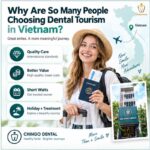
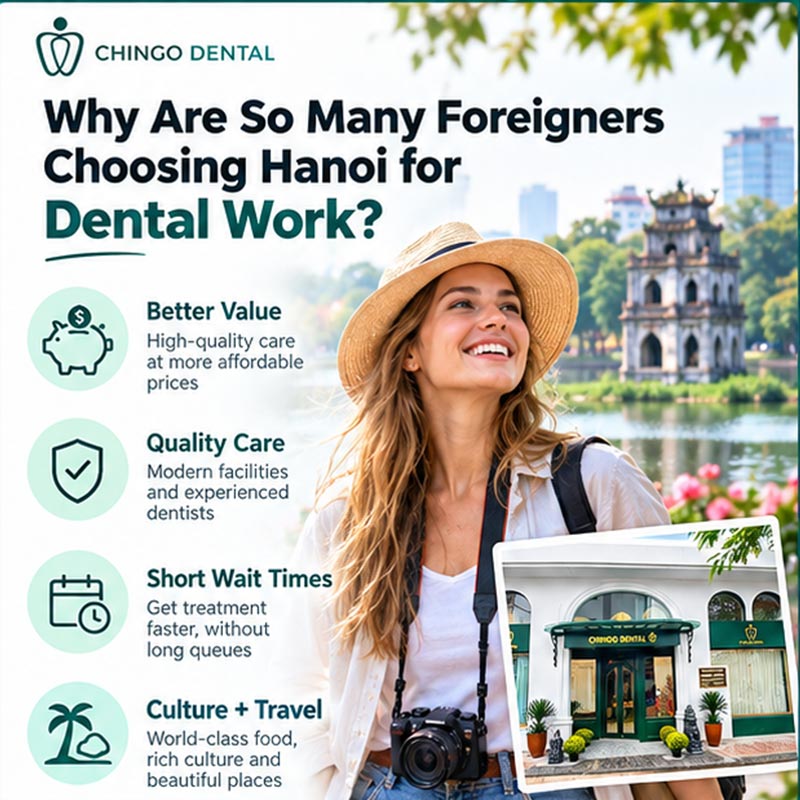
Why are so many foreigners choosing hanoi for dental work?
The answer starts with cost, but it does not end there.
A dental implant in Australia typically runs between AUD 4,500 and AUD 6,500 per tooth. In the UK, a single implant with the crown can reach £3,000. In Hanoi, the same procedure performed by a qualified specialist using imported implant components costs between USD 700 and USD 1,500 depending on the material and clinic. That gap is not a reflection of lower standards. It reflects a difference in overhead costs, labor markets, and clinic operating models.
The same logic applies to cosmetic dentistry. Porcelain veneers in London or Sydney can cost £700–£1,000 per tooth. At a well-equipped clinic in Hanoi, a single veneer using premium Emax or Zirconia material sits in the USD 150–300 range. For patients looking at six to ten veneers as part of a smile makeover, the total savings can easily exceed USD 5,000 enough to cover flights, accommodation, and a proper Hanoi experience several times over.
But international patients are not just drawn by affordable dental care. They return because the experience itself has improved dramatically. Modern clinics serving foreign visitors now offer bilingual consultations, detailed written treatment plans with line-item pricing provided upfront, and communication via email or WhatsApp before you even land. For expats and long-stay travelers in particular, this level of accessibility makes dentistry in Hanoi a genuinely practical option rather than a compromise.
There is also the city itself. Hanoi rewards exploration. Between appointments, patients spend mornings in the Old Quarter, take day trips to Ninh Binh or Ha Long Bay, and eat exceptionally well. For many international visitors, a dental holiday in Hanoi structured around a treatment schedule but lived like a proper trip turns out to be the most enjoyable way they have ever approached dental care. Searching for the right dental clinic in Hanoi is the first practical step, and the criteria for making that choice well are worth understanding before you start comparing prices.
What treatments do dental tourists in hanoi actually come for?
Not every dental procedure is worth traveling for. Short, uncomplicated treatments with high cost differentials offer the best return on a dental trip.
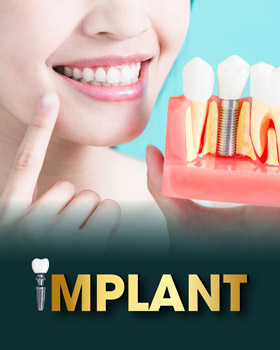
Dental implants are consistently the top reason international patients visit Hanoi. The procedure involves placing a titanium post in the jawbone to replace a missing tooth root, then attaching a crown on top. Because it typically requires two visits spaced eight to twelve weeks apart one for placement, one for the final crown some patients plan two separate short trips, while others choose clinics offering express protocols that compress the timeline. The cost dental implant in hanoi savings on even a single implant more than justify the travel investment for most patients flying from Australia, New Zealand, or Western Europe.
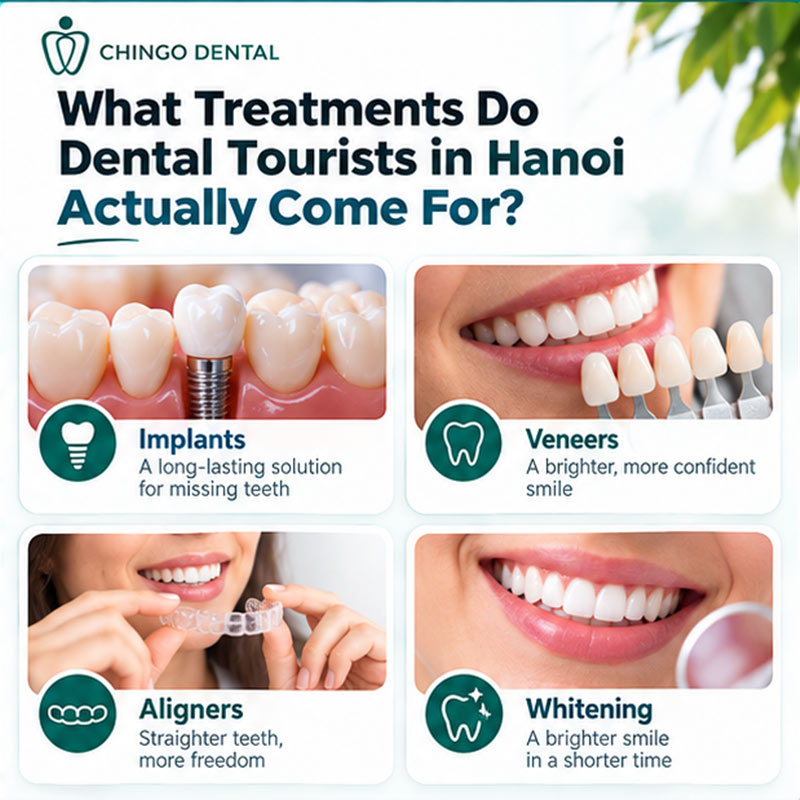
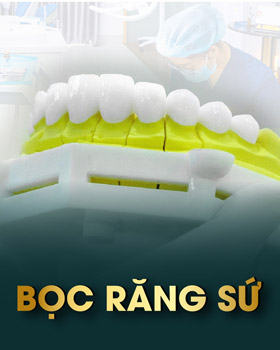
Porcelain veneers are the second most popular treatment. Veneers are thin shells of ceramic material bonded to the front surface of teeth to change their shape, color, or length. They are a cornerstone of cosmetic dentistry and one of the procedures where Hanoi’s price advantage is most pronounced. A full smile transformation with eight to ten veneers, done using high-grade Emax porcelain, can be completed in three to five days. Many patients plan a working holiday around the treatment schedule.
Ceramic and Zirconia crowns attract patients who need to restore damaged or heavily filled teeth. Zirconia crowns in particular have become the material of choice for their durability and natural translucency. In Hanoi, same-day crown fabrication is now available at clinics equipped with in-house CAD/CAM milling units.
Full mouth restorations draw patients who need a combination of implants, crowns in hanoi, and veneers. These cases require more planning and a longer stay typically ten to fourteen days, but the total savings compared to treatment at home can run into tens of thousands of dollars.
Teeth whitening is a popular add-on. Many patients schedule a professional whitening session alongside a more complex procedure, using the few days between appointments to fit it in.
|
Treatment |
Typical cost in Hanoi (USD) |
Typical cost in Australia (AUD) |
|
Single dental implant |
$700 – $1,500 |
$4,500 – $6,500 |
|
Porcelain veneer (Emax) |
$150 – $350/tooth |
$1,200 – $2,000/tooth |
|
Zirconia crown |
$150 – $300/tooth |
$1,500 – $2,500/tooth |
|
Teeth whitening (in-clinic) |
$80 – $200 |
$600 – $1,200 |
|
Full mouth restoration |
Custom quote |
Custom quote |
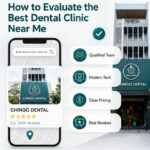
How do you know a dental clinic in hanoi is actually good?
This is the question that deserves the most honest answer. Not every clinic in Hanoi operates at the same level. The price difference between a reliable clinic and a budget option can be significant and the reasons are not arbitrary.
Start with technology.
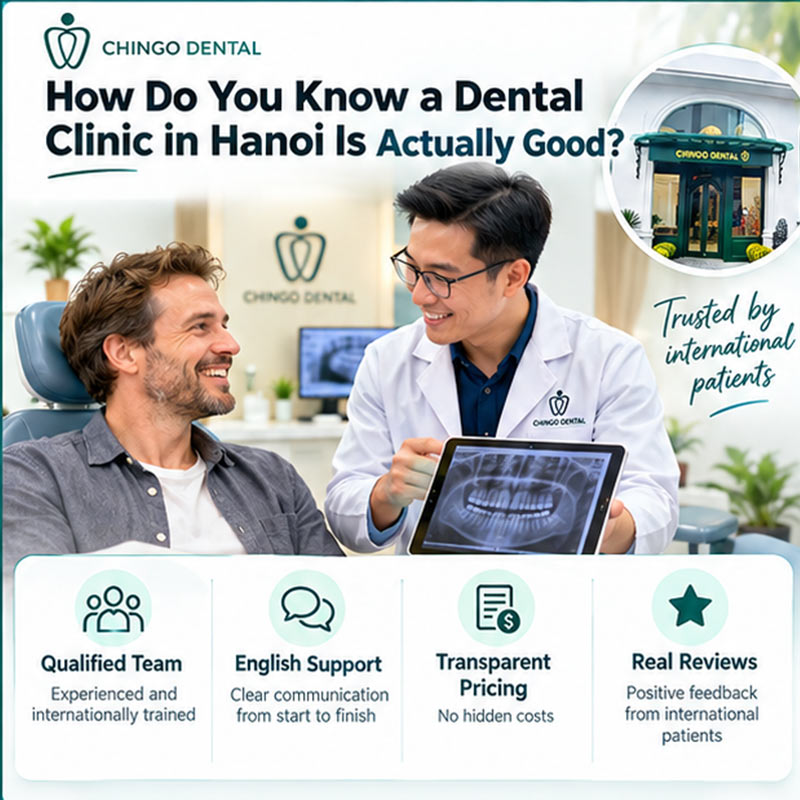
The standard of care at a modern clinic in Hanoi is directly tied to its diagnostic and treatment equipment. A clinic worth considering for dental tourism should have, at minimum, a CT Cone Beam 3D scanner. Unlike a standard dental X-ray, a cone beam scan produces a three-dimensional image of the jaw, bone density, and surrounding anatomy. For implant planning in particular, this level of detail is not optional it determines whether the implant position is safe, stable, and anatomically correct. Clinics without this technology are asking you to accept a higher margin of uncertainty in your treatment planning.
For cosmetic cases involving veneers or crowns, look for in-house Digital Smile Design. This digital workflow allows the dentist to simulate your final result before any tooth preparation begins. You see what your smile will look like, approve it, and the design is then used to guide the actual procedure. It is a meaningful safeguard, not a marketing feature.
Prioritize English communication.
Not because it is convenient though it is but because clear communication is a clinical requirement. A dentist who cannot explain your diagnosis, your treatment options, and the expected outcome in a language you fully understand is a dentist whose advice you cannot properly evaluate. The best clinics serving international patients in Hanoi employ bilingual staff throughout the patient journey: from the first consultation to the final appointment.
Ask for a written quote before you commit.
Any reputable clinic offering dental care to international patients should provide a detailed, itemized cost breakdown before treatment begins. This is not a difficult request. It protects you and it signals that the clinic operates transparently. Clinics that resist or delay providing pricing information in writing are worth avoiding.
Read patient reviews – the right way.
Look for reviews from patients who had the same treatment you are considering, written recently, with specific detail about their experience. Generic five-star reviews without substance tell you very little. Reviews from international patients who discuss the consultation process, communication quality, and follow-up care are far more informative.
Chingo Dental Hanoi: what international patients actually experience
Among the clinics in Hanoi that specifically serve international patients, Chingo Dental has built its reputation on a combination of technology access and communication quality that is harder to find than it sounds.
The clinical setup at Chingo is built around precision tools that support more predictable outcomes. CT Cone Beam 3D scanning is used as standard in implant planning not offered as an upgrade. The clinic’s CAD/CAM unit allows in-house fabrication of ceramic restorations, which reduces turnaround time and eliminates the quality variation that comes with outsourcing to a third-party laboratory. For surgical procedures including complex extractions, the clinic uses Piezotome ultrasonic technology, which is gentler on surrounding bone and soft tissue than conventional surgical instruments. Recovery tends to be faster and more comfortable as a result.
For patients planning a cosmetic transformation, Chingo’s Digital Smile Design workflow is one of the more thorough implementations in Hanoi. The process begins with digital photographs and a bite analysis, moves into a simulated design preview that the patient reviews and adjusts, and only then proceeds to tooth preparation. Patients who have gone through this process often describe the final result as matching closely sometimes identically to the preview they approved at the start.
The bilingual team is not just a front-of-house feature. Dentists at Chingo communicate in English throughout the clinical consultation, not just at reception. Treatment plans are written in English and provided as documents the patient keeps. For patients coordinating a dental trip from overseas, this makes pre-arrival planning significantly easier: specific questions about case complexity, material selection, and timeline can be answered in writing before booking flights.
Chingo also operates a clinic in Da Nang, which expands the options for international patients traveling in Vietnam. For patients who plan to spend time in central Vietnam or who prefer a beachside recovery dentistry in Da Nang at the same standard is available at the same clinic group. Some patients split their treatment between the two locations based on their travel itinerary. The continuity of care and clinical records between the Hanoi and Da Nang locations makes this practical.
If you are in the planning stage, Chingo offers free online consultations before you arrive. Sending photographs and describing your dental concerns via WhatsApp or email will get you a preliminary treatment plan and cost estimate enough to make a fully informed decision before committing to travel.
How should you plan the logistics of a dental trip to Hanoi?
The planning question most patients get wrong is time. They underestimate how much of their schedule is actually free between appointments, and they overestimate how exhausting the treatment process will be.
For teeth whitening or a single crown, a two-day stay is genuinely sufficient. For veneers on six to ten teeth, plan for four to six days two substantive appointments with a day or two in between for the laboratory work. Dental implants require a different approach: the two-stage process means most patients plan either two short trips or a longer single visit that combines the implant placement with another procedure.
|
Treatment |
Recommended minimum stay |
|
Teeth whitening |
1 – 2 days |
|
Porcelain veneers (6 – 10 teeth) |
4 – 6 days |
|
Single dental implant |
2 – 3 days (placement only) + return visit |
|
Full mouth restoration |
10 – 14 days |
Where to stay. Chingo Dental’s Hanoi clinic is centrally located, which puts it within easy reach of the city’s main accommodation areas. Hoan Kiem and the Old Quarter offer the densest concentration of hotels across all price ranges, and the distances involved make walking or a short taxi ride the practical way to get to appointments. The combination of central accommodation and a central clinic means most patients spend their between-appointment time in the most interesting part of the city.
Before you travel. If you have recent dental X-rays or scans from your dentist at home, bring them or send them ahead. They may not be usable depending on format, but they provide useful context for your consultation and can save time. Make sure your travel insurance covers dental emergencies not treatment, which most policies exclude, but complications. And confirm everything in writing with the clinic before you book flights your treatment plan, your appointment schedule, and the total cost.
Hanoi vs. Bangkok vs. Seoul: Is Hanoi actually the best choice?
Thailand and South Korea are the other two dental tourism destinations that English-speaking patients most commonly consider. The honest comparison is more nuanced than the marketing materials on either side suggest.
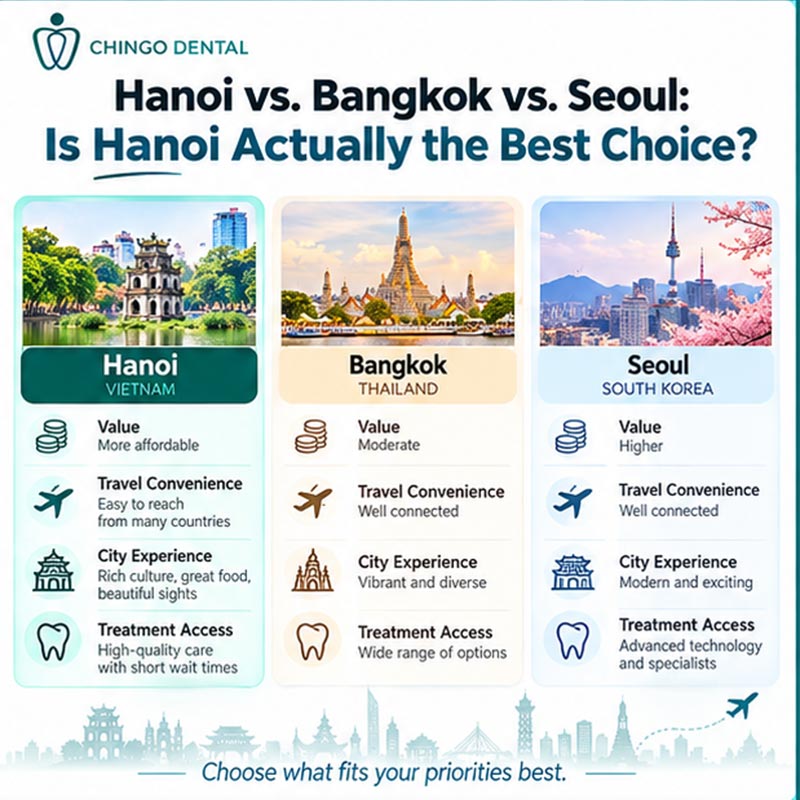
Bangkok offers similar technology access and a well-established medical tourism infrastructure. Costs for major procedures are comparable to Hanoi, sometimes slightly higher at international-facing clinics. Seoul’s dental clinics are technically sophisticated and the country has a strong track record in implant dentistry specifically but costs are meaningfully higher, and the combination of language barriers and longer flights from most Western countries makes it a less practical option for most patients.
Hanoi’s advantages are real. The cost of living in Vietnam makes accommodation, food, and transportation between appointments genuinely inexpensive. The quality gap between Hanoi and Bangkok has narrowed considerably over the last five years as Vietnamese clinics have invested in the same generation of European and Korean clinical equipment. For patients traveling from Australia or New Zealand, the flight time to Hanoi is comparable to Bangkok while the total travel budget including flights, accommodation, and treatment frequently comes out lower.
It is also worth noting that dental tourism in Hanoi has matured in ways that are not always visible in online comparisons. Hanoi now has clinics that have been serving international patients consistently for a decade or more, building up case experience specifically with the oral health profiles, aesthetic preferences, and communication needs of Western patients. That accumulated experience shows in ways that are hard to quantify: how clearly a dentist explains a treatment recommendation, how accurately a veneer color is matched to adjacent teeth, how smoothly a multi-stage implant case is coordinated across two visits. These are outcomes that come from repetition, not just equipment.
For patients who want to combine dental care with broader travel in Vietnam, dental tourism in Hanoi also offers the flexibility of pairing treatment with visits to other parts of the country. Hanoi sits close to Ha Long Bay, Sapa, and Ninh Binh in the north, while patients who extend their trip can continue south through Hoi An, Da Nang, and Ho Chi Minh City. The dual-city availability of certain clinic groups including Chingo Dental’s presence in both Hanoi and Da Nang makes it genuinely possible to start treatment in one city and continue or complete it in another, which suits longer travel itineraries well.
The question of dentistry in Hanoi versus other destinations ultimately comes down to the specific clinic you choose, not the city. A well-equipped, internationally oriented practice in Hanoi offers outcomes that are fully competitive with the best dental tourism clinics anywhere in Asia.
Frequently asked questions about dental tourism in Hanoi (FQA)
Question 1. Is dental care in Hanoi safe for foreign patients?
At established clinics with proper sterilization protocols, modern equipment, and qualified dental practitioners, the standard of care is genuinely high. The key is choosing the right clinic. Look for documented sterilization procedures, in-clinic technology (not just outsourced laboratory work), and clear communication about your treatment plan. The clinics that serve regular international patients maintain these standards because their reputation depends on it.
Question 2. How much can I realistically save on dental implants in Hanoi compared to Australia?
A patient needing four implants in Australia might face a total cost of AUD 18,000 – 26,000. The same four implants at a reputable Hanoi clinic would typically fall in the USD 3,000 – 6,000 range, depending on materials and case complexity. After flights and accommodation, the net saving for an Australian patient is typically still USD 10,000 or more for a case of that size.
Question 3. Do the dentists at Hanoi clinics speak English?
At clinics specifically serving international patients including Chingo Dental, yes. English communication is available throughout the clinical consultation and treatment process, not just at reception. This is worth confirming before you book, as it varies significantly between clinics in the city.
Question 4. Can I get dental implants completed in a single visit to Hanoi?
The standard implant protocol involves two stages separated by a healing period. Some clinics offer accelerated protocols particularly for patients with sufficient bone density that compress the timeline into a single longer visit. This is worth discussing during your pre-arrival consultation. It depends on your specific anatomy and the number of implants needed.
Question 5. What happens if I have a problem after I return home?
This is a fair concern. Reputable clinics handling international patients are equipped to manage follow-up remotely. For minor questions or concerns, communication via WhatsApp or email is typically fast and responsive. For issues that need clinical assessment, your regular dentist at home can evaluate and provide first-line care, while the original treating clinic can provide documentation of materials used, implant specifications, and treatment records.
Question 6. Does travel insurance cover dental work done in Hanoi?
Standard travel insurance policies typically do not cover elective dental treatment. They do, in most cases, cover dental emergencies that arise unexpectedly during travel. If you are traveling specifically for a planned procedure, check your policy wording carefully and consider whether supplemental coverage is appropriate.
Ready to plan your dental trip to Hanoi?
The case for dental tourism in Hanoi has never been stronger. The cost savings are real and substantial. The technology available at top clinics now matches international standards. The city itself makes the time between appointments genuinely enjoyable rather than a logistical burden.
The one decision that determines the quality of the entire experience is which clinic you choose. At Chingo Dental Hanoi, international patients get access to CT Cone Beam-guided implant planning, in-house CAD/CAM fabrication, Digital Smile Design previews, and a fully bilingual team in a clinic that has made serving foreign patients a core part of its practice, not an afterthought.
If you are considering cosmetic dentistry or a more complex procedure and want to understand what is possible within your budget and timeline, reach out to Chingo Dental before you book your travel. Their team can review your case, provide a written cost estimate, and outline a realistic treatment schedule so that when you land in Hanoi, the plan is already in place.
Contact Information – Chingo Dental International Cosmetic Dentistry
Chingo Hanoi Branch:
- Address: No. 1, Lane 558 Nguyen Van Cu Street, Bo De Ward, Hanoi City
- Hotline: 0915.217.855 – 0912.391.909 – 0978.090.780
Chingo Da Nang Branch:
- Address: No. 22 Le Hong Phong Street, Hai Chau Ward, Da Nang City Da Nang
- Hotline: 0916.019.696 – 0919.590.326 – 0916.102.552
Opening hours: 8:00 AM – 8:00 PM, all days of the week
Email: info@chingodental.vn
Website: https://chingodental.vn
This article is intended for informational purposes. Individual treatment plans and costs vary based on clinical assessment. Consult a qualified dental professional before making any treatment decisions.