A chipped tooth. A smile you hide in photos. Stubborn stains that no whitening kit can shift. These are the moments when people start searching for porcelain veneers and for good reason. Porcelain veneers are one of the most effective, long-lasting solutions in cosmetic dentistry today. They can reshape, whiten, and completely reimagine a smile in just two to three appointments. But before you commit, it helps to understand exactly what you are getting into. What the procedure involves, who it suits, and what separates a result you will love from one you will regret.
This guide covers everything honestly and in plain English. From the science behind the material to the actual day-to-day experience of having veneers placed. And if you are based in Vietnam, you will also find out why patients seeking cosmetic dentistry in Da Nang and Hanoi are choosing Chingo Dental as their first call.
Quick Summary
Porcelain veneers are ultra-thin ceramic shells bonded to the front surface of teeth to improve their appearance.
The procedure typically takes two to three visits and is minimally invasive.
With proper care, high-quality porcelain dental veneers can last 15 to 20 years.
What are porcelain veneers, and what can they actually fix?
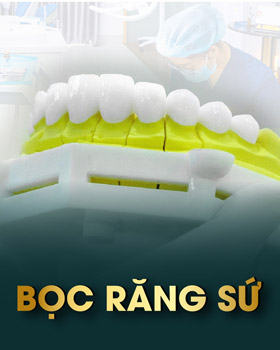
Porcelain veneers are wafer-thin shells made from dental-grade ceramic that are permanently bonded to the front surface of natural teeth. Each shell is custom-crafted in a dental laboratory to match the exact shape, size, and shade that suits a patient’s face and smile goals. The result is a transformation that looks natural because the material itself mimics the light-reflecting properties of real tooth enamel.
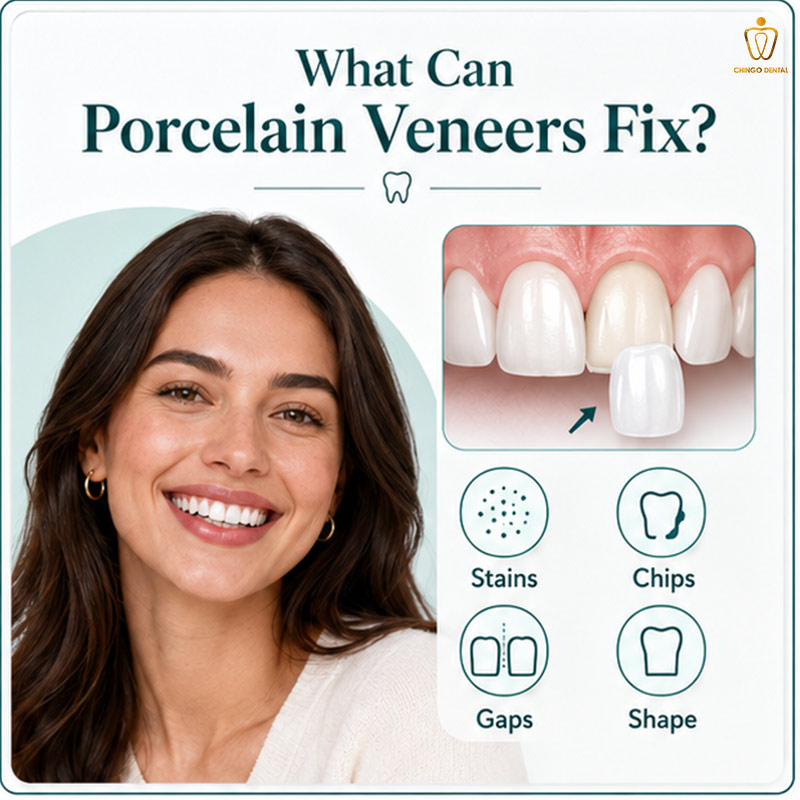
People come to cosmetic dentistry looking for solutions to a wide range of concerns. Porcelain veneers address most of them in a single treatment. Permanent discolouration that does not respond to whitening. Caused by tetracycline antibiotics, fluorosis, or old root canals disappears completely behind a veneer. Chips, cracks, and minor fractures are covered. Small gaps between teeth close visually without orthodontic treatment. And teeth that are slightly uneven in length or shape can be harmonised so the whole smile reads as balanced.
It is worth being clear about what veneers cannot do. They are not a fix for severely crowded teeth, deep bite problems, or significant structural damage. In those cases, a dentist will recommend orthodontics or a dental crown instead. But for anyone whose main concern is the way their smile looks, the colour, shape, symmetry, or surface texture. Tooth porcelain veneers are arguably the most powerful tool available.
How are porcelain veneers different from composite veneers?
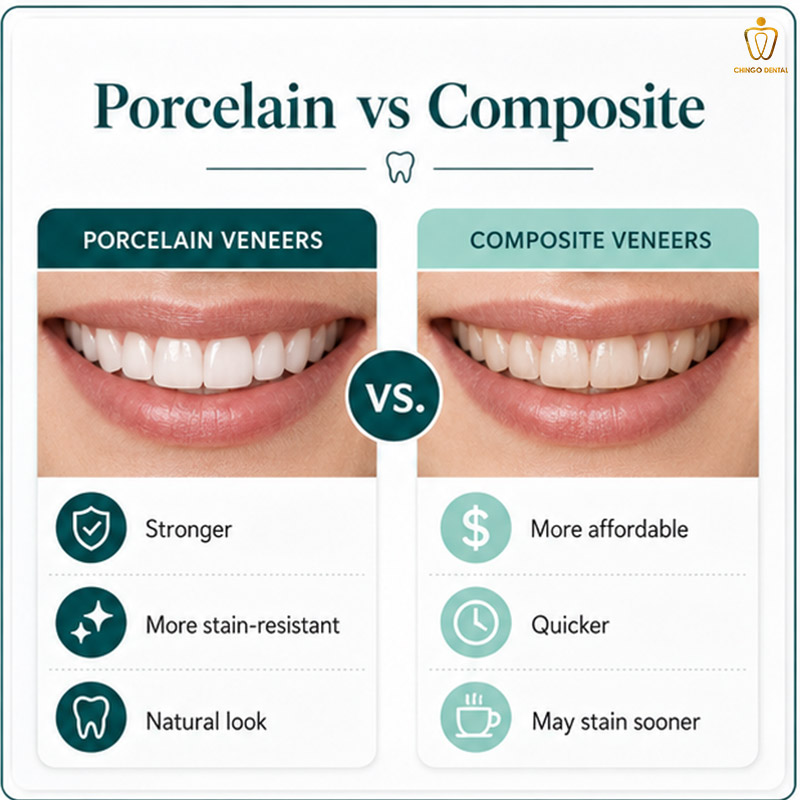
Composite veneers are applied chairside, sculpted directly onto the tooth using resin and hardened with a curing light. They can be completed in a single visit, which makes them faster. Porcelain dental veneers, by contrast, are fabricated in a laboratory from ceramic and then bonded at a second appointment. The extra step matters because it allows for a far more precise fit, a more translucent finish, and a surface that resists staining over years of use.
Composite resin tends to pick up coffee and wine staining within three to five years. Dental porcelain stays colour-stable for well over a decade. For patients who want a result that ages gracefully and holds up under daily life, porcelain is the clear choice.
How do porcelain veneers work? The material science behind the smile
The reason porcelain veneers look so convincingly natural comes down to the optical properties of the material. Dental porcelain is slightly translucent, meaning light passes into the surface and bounces back in a way that mirrors natural enamel. This is what separates a good veneer from one that looks like a white cap glued onto a tooth.
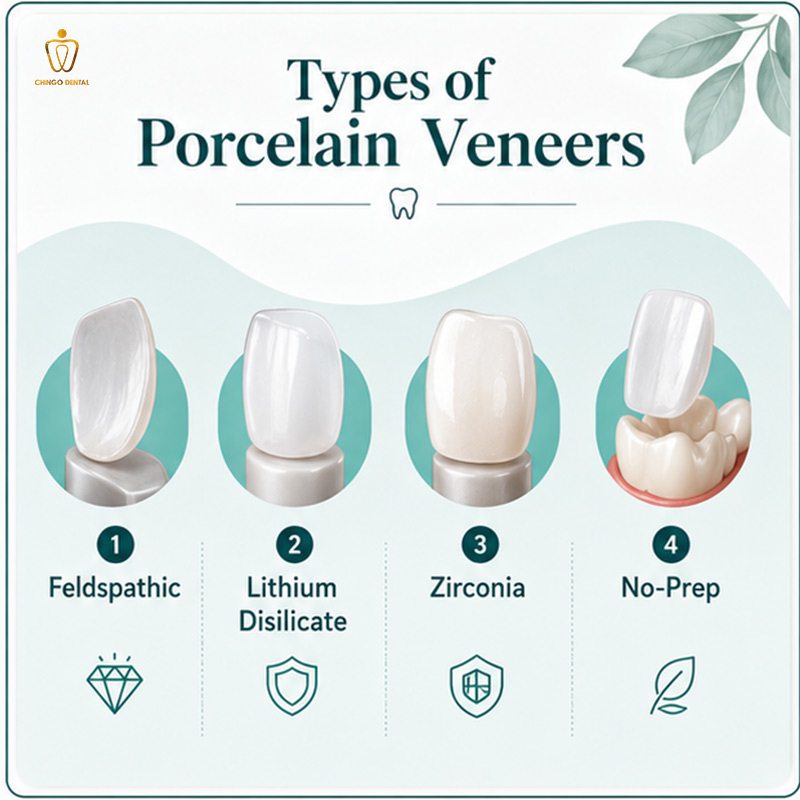
There are two main ceramic systems used in dentistry for veneers. Feldspathic porcelain and lithium disilicate (more commonly known by the brand name e.max).
Feldspathic porcelain veneers are hand-layered by a ceramist and are the gold standard for aesthetics. They can be made as thin as 0.3 millimetres, which means minimal tooth reduction is needed. Lithium disilicate veneers offer slightly more strength at the cost of a small reduction in translucency. They are a good choice for patients with a heavy bite or those who grind their teeth mildly.
Bonding is the other critical part of the process. The dentist uses a dental adhesive resin that chemically fuses the porcelain shell to the enamel of the tooth. When done correctly, the bond is extremely durable. The veneer effectively becomes part of the tooth structure. It does not come loose under normal eating and speaking conditions, and it can tolerate the forces of biting when properly designed.
How long do porcelain veneers last?
With good home care and regular dental check-ups, high-quality porcelain dental veneers last between 10 and 20 years. Some patients have had their veneers in place for over two decades without needing replacement. The lifespan depends on the quality of the laboratory work, the precision of the bonding procedure, and how well the patient maintains their oral health. Grinding teeth at night, biting nails, or using teeth as tools significantly shortens that timeline.
Who is a good candidate for porcelain veneers?
Porcelain veneers work best when the foundation is solid. A good candidate has healthy gums, no active cavities, and enough enamel on the tooth surface to allow for bonding. The concerns being addressed are primarily cosmetic, colour, shape, minor spacing, or surface irregularities rather than structural or functional.
People who clench or grind their teeth heavily (a condition called bruxism) need to address that habit first, or in parallel, because the forces generated during grinding can fracture even well-made porcelain. A custom night guard is often recommended alongside veneers for these patients. Similarly, if severe misalignment is the main issue, orthodontic treatment will typically deliver a better long-term outcome than covering the problem with ceramic.
Age is not a hard barrier, but dentists prefer to wait until the late teens when jaw development is complete and teeth have fully erupted. Beyond that, veneers suit adults of any age who are committed to maintaining their oral health.
A practical note for expats considering dental veneers abroad
Many international patients considering cosmetic dentistry in Da Nang or Hanoi plan their treatment across two trips or combine it with an existing stay in Vietnam. The standard porcelain veneer procedure requires two to three appointments spaced about two weeks apart. Which fits naturally into a longer holiday or a business trip. It is important to stay in contact with the clinic after returning home and to have a local dentist available for any minor follow-up if needed. Chingo Dental provides English-language aftercare support and can coordinate with dentists internationally to ensure continuity of care.
What types of porcelain dental veneers are available?
Not all porcelain veneers are the same, and understanding the differences helps when making a decision. The main distinction is between traditional (preparation) veneers and minimal-prep or no-prep veneers. And within each category, the choice of ceramic material matters too.
Traditional Veneers
Traditional porcelain veneers require the dentist to remove a small amount of enamel from the front of the tooth usually between 0.3 and 0.7 millimetres. This creates space for the veneer to sit flush with the neighbouring teeth and ensures it bonds securely. The tooth reduction is permanent, which is why the decision to get veneers should not be taken lightly. However, when done conservatively by an experienced cosmetic dentist, the preparation is minimal and causes no sensitivity in the majority of cases.
Minimal-prep and no-prep veneers
For patients with naturally small or receding teeth, it is sometimes possible to place veneers with very little or no enamel removal. These options depend entirely on the existing tooth shape and the desired outcome. Not everyone is a candidate, and forcing a no-prep approach onto teeth that need preparation produces a result that looks bulky and unnatural. An honest clinician will tell you which approach your teeth require.
Feldspathic vs. E.max veneers – which is better?
Feldspathic porcelain is the choice of experienced cosmetic dentists who prioritise aesthetics above all. It is hand-layered, deeply translucent, and can be customised in colour and texture to a remarkable degree. E.max (lithium disilicate) is stronger and more forgiving, which makes it a sensible choice for patients who need a full set of veneers across the back teeth as well, or who have a strong bite. At Chingo Dental, the clinical team selects the material based on each patient’s individual assessment not a one-size-fits-all protocol.
What does the porcelain veneer procedure look like, step by step?
Understanding the process removes a lot of anxiety. Here is what actually happens when you get porcelain veneers at Chingo Dental.
Step one: smile design consultation
The process starts with a detailed consultation. The dentist examines the teeth, takes photographs, and discusses what the patient wants to change. Many modern clinics, including Chingo Dental, use digital smile design software at this stage. Projecting a simulation of the proposed result onto a screen so the patient can see and give feedback before any treatment begins. This is the single most important step, because it aligns expectations and ensures the final result reflects what the patient actually wants.
Step two: tooth preparation and impression
At the second appointment, the dentist prepares the teeth under local anaesthetic. A small, precise amount of enamel is removed from the front surface of each tooth being treated. Impressions are taken either with traditional putty or with a digital intraoral scanner and sent to the dental laboratory. Temporary veneers are placed over the prepared teeth to protect them and give the patient a preview of the final appearance.
Step three: final bonding
When the laboratory has finished crafting the custom porcelain veneers, the patient returns for the bonding appointment. The temporaries are removed, and the new veneers are tried in dry to check fit and colour. Small adjustments can still be made at this stage. Once both the patient and dentist are satisfied, the surfaces are cleaned, etched, and the veneers are bonded permanently using dental adhesive resin and a curing light. The dentist then checks the bite and polishes the edges. Most patients walk out of this appointment ready to smile for photos immediately.
Porcelain veneers vs. Composite veneers vs. Dental crowns: a clear comparison
Choosing the right treatment means understanding the trade-offs. The table below summarises the key differences across the three most common options in cosmetic and restorative dentistry.
Feature
Porcelain Veneers
Composite Veneers
Dental Crowns
Material
Dental porcelain / ceramic
Composite resin
Porcelain or metal-ceramic
Thickness
0.3 – 0.7 mm
0.5 – 1.5 mm
1.5 – 2.0 mm (full)
Durability
10 – 20 years
5 – 7 years
10 – 15 years
Tooth prep
Minimal enamel removal
Minimal to none
Significant reduction
Aesthetics
Excellent, highly natural
Good, less translucent
Very good
Best for
Cosmetic smile changes
Single tooth / quick fix
Damaged or broken teeth
The takeaway is straightforward. Porcelain teeth veneers offer the best combination of aesthetics and longevity for purely cosmetic concerns. Composite veneers are a reasonable short-term option or a stepping stone. Dental crowns are appropriate when the tooth is structurally compromised not as a cosmetic fix for a healthy tooth.
How much do porcelain veneers cost? Vietnam vs. Western countries
Cost is one of the main reasons international patients investigate cosmetic dentistry in Vietnam, and the savings are real. In the United States, a single porcelain veneer typically costs between USD 1,000 and USD 2,500. In the United Kingdom, the range sits at roughly GBP 600 to GBP 1,200 per tooth. A full-smile makeover covering 8 to 10 veneers in either country can run to USD 15,000 or more.
At Chingo Dental, the cost of porcelain dental veneers in Da Nang is a fraction of those figures without any compromise on the quality of materials or laboratory work. The clinic uses internationally certified ceramics and works with premium dental labs. Patients combining their treatment with time spent in Hanoi or Da Nang often find that the savings more than cover their entire trip.
The final cost depends on the number of teeth being treated, the material selected, and whether any preparatory work is needed. Chingo Dental provides a transparent, itemised quote at the initial consultation, so there are no surprises. If you want to get a clearer sense of pricing before booking, you can contact the team directly for a preliminary estimate based on your photos and concerns.
Why does Chingo Dental stand out for porcelain veneers in Vietnam?
Vietnam has no shortage of dental clinics, and the standard of cosmetic dentistry has risen significantly over the past decade. So what makes Chingo Dental a clinic worth choosing specifically for porcelain veneers?
The first reason is clinical specialisation. Chingo Dental’s cosmetic team focuses specifically on aesthetic outcomes. Smile design, proportion, colour matching, and natural-looking results are the core of what they do. This is not a general practice that offers veneers as one of fifty services. It is a clinic where cosmetic dentistry is the primary discipline.
The second reason is communication. Most international patients seeking dentistry in Hanoi or dentistry in Da Nang have had frustrating experiences trying to navigate treatment in a second language. Chingo Dental operates in English. The consultation, treatment planning, and aftercare process are all handled by English-speaking staff, which means patients can ask real questions and get real answers rather than nodding along and hoping for the best.
The third reason is transparency. Before any enamel is touched, patients see a detailed digital simulation of the proposed result. If they want changes longer teeth, a slightly warmer shade, a different edge shape. Those adjustments are made in the design phase, not after the porcelain veneers have been fabricated. This approach significantly reduces the chance of dissatisfaction and ensures the patient has full ownership of the outcome.
One patient from Australia, who had her upper six veneers done at Chingo Dental while working in Hanoi, described the experience this way: the team took time to understand what she actually wanted, showed her the digital preview, gave her time to think, and then delivered a result that matched the simulation almost exactly. She noted that the level of detail in the consultation alone was more thorough than anything she had experienced at home.
Chingo Dental has clinic locations in both Hanoi and Da Nang, making it accessible whether you are living in the capital or visiting the central coast. Both locations maintain the same standards of equipment, materials, and clinical protocols.
How to care for porcelain veneers and make them last
Veneers do not require dramatically different care from natural teeth, but a few habits make a meaningful difference to their lifespan.
Brush twice daily with a non-abrasive fluoride toothpaste. Regular toothpastes with whitening microbeads or high-abrasive formulas can dull the surface of dental porcelain over time. Floss once a day, paying particular attention to the gumline around each veneer. Gum health is not directly related to the veneers themselves, but gum recession can expose the bonding margin and affect the appearance of the restoration.
Avoid biting directly into very hard foods crusty bread, raw carrots, ice with the front veneer teeth. Use a side bite. Avoid habits like biting nails, chewing pen caps, or using teeth to open packaging. These are the most common causes of chipped veneers.
If you grind your teeth at night, wear the night guard your dentist provides. Grinding generates far more force than normal chewing, and it is one of the few things that can fracture a well-made porcelain veneer. The guard is not optional. Porcelain dental veneers that receive attentive maintenance routinely last 15 to 20 years.
Frequently asked questions about porcelain veneers (FQA)
Question 1. Are porcelain veneers permanent?
The tooth preparation involved in placing traditional porcelain veneers is permanent. A small amount of enamel is removed and cannot be replaced. This means the teeth will always need to be covered by veneers or another restoration. The veneers themselves, however, can be replaced when they eventually wear out, typically after 10 to 20 years.
Question 2. Do porcelain veneers look natural?
High-quality porcelain dental veneers are remarkably natural in appearance. Dental porcelain reflects light in the same way as natural enamel, which is what makes it so convincing. The key is working with a skilled ceramist and a dentist who understands smile aesthetics. Proportion, shade, surface texture, and how the veneers relate to the lips and face as a whole. At Chingo Dental, the digital smile design process ensures every patient approves the look before treatment begins.
Question 3. Is the porcelain veneer procedure painful?
The procedure is carried out under local anaesthetic, so there is no pain during the appointment. Some patients experience mild sensitivity for a few days after tooth preparation, while the temporary veneers are in place. This settles completely once the permanent veneers are bonded. Most patients are surprised by how comfortable the process is.
Question 4. What is the difference between porcelain veneers and porcelain teeth?
The term ‘porcelain teeth’ often refers colloquially to dental crowns or full dentures made from porcelain. Porcelain veneers are distinct: they are thin shells bonded to the front surface of existing natural teeth and do not cover the entire tooth. Veneers preserve much more of the natural tooth structure than crowns, which require significant reduction on all sides.
Question 5. Can I get veneers on all my teeth?
It is technically possible to place veneers across all visible teeth, but most smile makeovers focus on the front six to ten teeth. The ones visible when you smile. The back teeth endure heavier chewing forces, making crowns a more suitable choice if those teeth need restoration.
Question 6. How do I get started with porcelain veneers at Chingo Dental?
The first step is a consultation, which can be booked online or by contacting the Chingo Dental team directly. You can send photos of your smile in advance for a preliminary assessment. The clinical team will discuss your goals, assess your suitability, and walk you through the treatment plan. Including timeline, materials, and transparent pricing before any commitment is made.
Ready to redesign your smile? Here is where to start
Porcelain veneers remain one of the most reliably transformative procedures in cosmetic dentistry. When the treatment is planned carefully, executed by skilled hands, and made from quality ceramic, the result is a smile that looks completely natural and lasts for well over a decade.
Chingo Dental brings that standard of care to patients in Hanoi and Da Nang in English, with transparent pricing, and with a process built around making sure you love the outcome.
Whether you are already living in Vietnam or planning a trip that combines travel and dental treatment, the team is available to answer questions, review photos, and help you decide whether porcelain veneers are the right next step for your smile.
Nha khoa tiêu chuẩn được Bộ y tế công nhận, giấy phép hoạt động số 0932/ĐNA-GPHĐ.
Chingo Dental luôn luôn lắng nghe, từng ngày nỗ lực hoàn thiện quy trình, quy chuẩn phục vụ khách hàng tối ưu. Chúng tôi luôn muốn đem đến cho bạn không chỉ hàm răng trắng đều, chắc khỏe, xinh đẹp mà còn là những trải nghiệm hết sức tuyệt vời.