If you’ve been looking into porcelain veneers, the first thing you probably noticed is how wildly the numbers vary. One clinic quotes you $900 per tooth. Another says $2,500. And then someone in a travel forum mentions getting a full set done in Vietnam for less than what a single veneer costs back home and walking away thrilled with the results.
So what’s actually going on with porcelain veneers cost? Is the price difference about quality, or just geography? And how do you know what’s a fair price for what you’re getting?
This guide walks through everything what drives the cost of porcelain veneers, what full-mouth pricing actually looks like, how Vietnam fits into the picture, and how it compares to other cosmetic options like teeth whitening and dental crowns.
Here’s what you’ll find in this article:
A clear breakdown of porcelain veneers cost per tooth and per full set, with real price ranges by country
The six factors that explain why two clinics can quote you completely different numbers
An honest look at veneers in Vietnam – what the price reflects, and what to look for in a clinic
A side-by-side comparison of veneers, teeth whitening, and dental crowns so you can choose the right treatment
Answers to the most common questions people ask before booking
What are porcelain veneers and are they right for you?
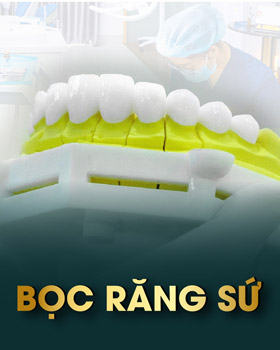
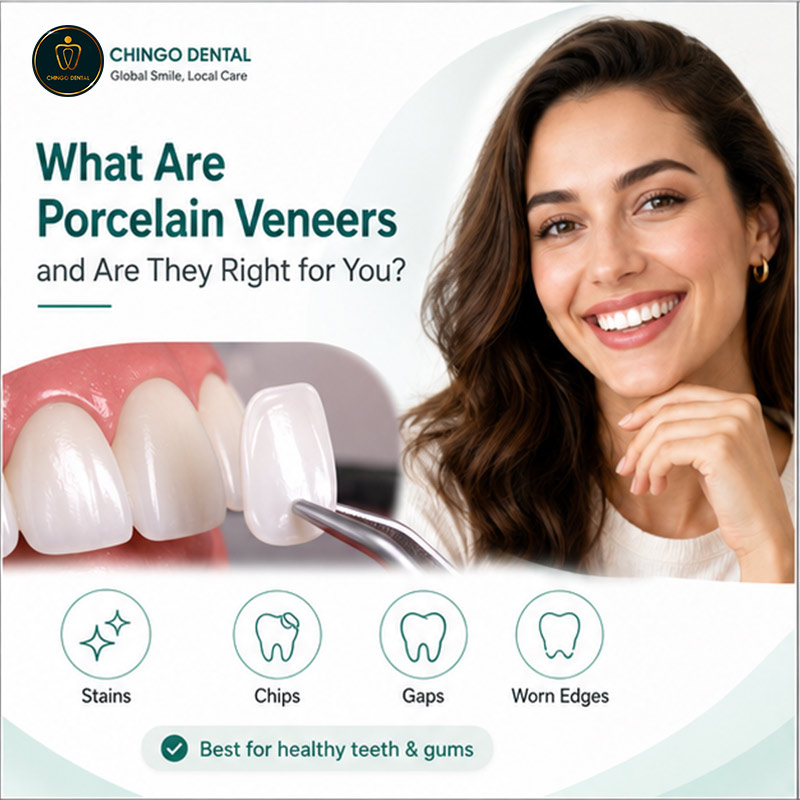
Porcelain veneers are ultra-thin ceramic shells, typically about 0.5mm thick, that are custom-made and bonded to the front surface of your teeth. Think of them as a permanent cosmetic upgrade for your smile. They change the shape, size, color, and overall appearance of teeth without the more extensive work involved in a crown.
Most people come in asking about veneers for one of a few reasons: stubborn staining that doesn’t respond to whitening, chips or cracks from old injuries, teeth that are slightly uneven or gapped, or simply wanting a brighter, more symmetrical smile. Veneers address all of these. They’re one of the most versatile tools in cosmetic dentistry. Which is part of why demand has grown so steadily in recent years.
The main materials you’ll encounter are traditional feldspathic porcelain, Emax (a lithium disilicate ceramic known for its translucency), and Zirconia (which is denser, stronger, and often used for back teeth or patients who grind). Each sits at a different price point, and that distinction matters more than most people realize when comparing quotes.
If your teeth are significantly decayed or structurally compromised, a veneer might not be the right call, a dental crown would offer better protection. For purely cosmetic concerns on healthy teeth, though, veneers tend to be the most conservative and visually impressive option available.
How much do porcelain veneers cost per tooth?
The honest answer is that porcelain veneers cost varies considerably depending on where you are in the world, what material is used, and who’s doing the work. But to give you a working framework, here are the typical ranges by country:
Country
Approximate Cost Per Tooth
United States
$900 – $2,500
United Kingdom
£500 – £1,500
Australia
AUD 1,200 – 2,000
Canada
CAD 900 – 2,000
Vietnam
$150 – $450
These figures reflect porcelain veneers specifically. Composite resin veneers, which are cheaper but shorter-lived, fall below these ranges in most markets.
What’s important to understand is that even within a single country, the spread is enormous. A cosmetic specialist in Manhattan charges very differently from a general dentist in rural Ohio, even if they’re using the same materials. The price of porcelain veneers reflects a combination of factors. Not just the ceramic itself, but everything that goes into designing, fabricating, and placing it correctly.
For someone based in the US or Australia looking at the full picture, the porcelain veneers price in Vietnam looks almost implausible at first glance. But as we’ll get into below, the lower cost isn’t about cutting corners on materials or skipping steps it’s about a fundamentally different cost of doing business.
How much does a full mouth of porcelain veneers cost?
When people ask about porcelain veneers cost for a full mouth, they usually mean the upper front teeth, the ones that show when you smile. Dentists refer to this as the “smile zone,” and it typically covers 8 to 10 teeth. A true full-mouth veneer treatment covering all 20 teeth is far less common and rarely necessary.
Here’s what a smile zone treatment typically costs:
Number of Veneers
USA (approx.)
Vietnam (approx.)
6 teeth
$5,400 – $15,000
$900 – $2,700
8 teeth
$7,200 – $20,000
$1,200 – $3,600
10 teeth
$9,000 – $25,000
$1,500 – $4,500
The gap between markets is hard to ignore. A patient getting 10 veneers in the US might spend $15,000 – $20,000. The same treatment in Vietnam, using the same Emax or Zirconia materials, might come in between $2,000 and $4,500.
This is why dental tourism to Vietnam has grown so significantly. For many patients. Especially expats already living in Southeast Asia, and international travelers who plan their trips around medical savings. Porcelain veneers cost full mouth simply makes more sense to pursue abroad.
One thing worth noting: a well-planned veneer case doesn’t get rushed. Good clinics use Digital Smile Design technology to mock up your final result before a single tooth is prepared. You’ll see your new smile on screen and sometimes in a trial prototype before committing. This process takes time and skill, and it’s one of the clearest indicators of a clinic that takes the aesthetic result seriously.
What actually drives the cost of porcelain veneers?
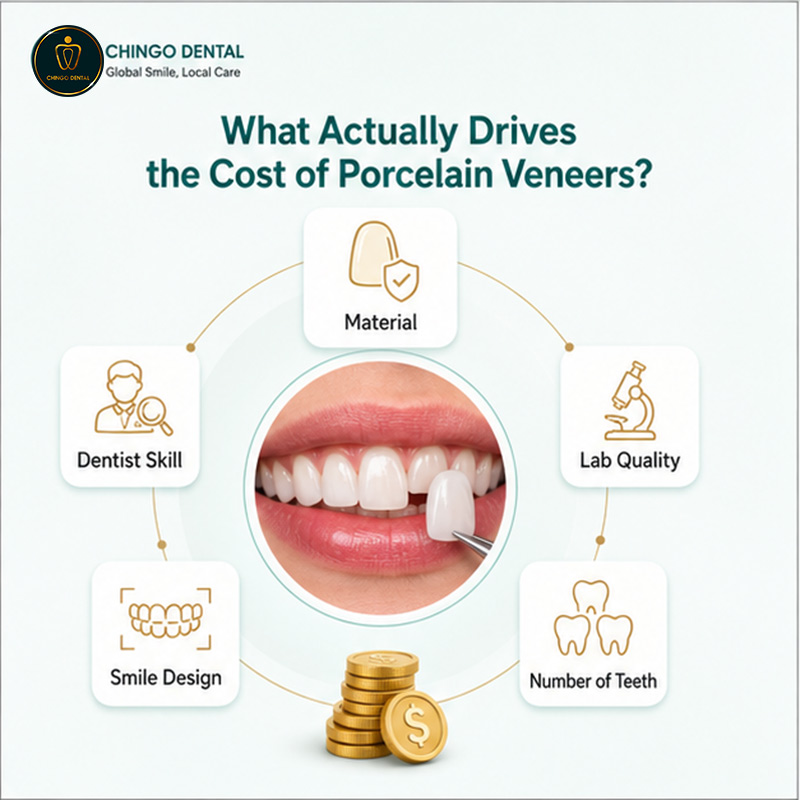
Understanding why prices differ so much helps you evaluate quotes intelligently and spot when something’s off. Six main factors shape what you’ll pay.
Material quality plays the biggest role. Emax ceramic produces a translucency that closely mimics natural tooth enamel. Zirconia is slightly less translucent but significantly stronger better suited to patients who clench or grind. Basic feldspathic porcelain costs less but chips more easily over time. The material chosen for your case isn’t just an aesthetic decision. It’s a clinical one.
The number of veneers matters in ways beyond simple multiplication. A case involving 8 teeth requires the dentist to achieve perfect symmetry and color matching across the whole arch. A technically demanding job that takes longer and requires more design skill than a single-tooth restoration.
How the veneers are made also affects cost significantly. Clinics with in-house CAD/CAM milling machines can fabricate veneers faster, sometimes in a single visit. Off-site dental labs, especially internationally accredited ones, may take longer but often produce exceptional results and their fees are built into what you pay.
The dentist’s training and specialization is a real differentiator. A dentist who has completed advanced training in cosmetic dentistry will charge more, and generally deliver more predictable aesthetic outcomes. This isn’t snobbishness cosmetic dentistry rewards experience in ways that general dental work doesn’t always.
Where the clinic is located drives a large portion of the price difference between countries. Overhead costs, rent, staffing, equipment maintenance, malpractice insurance are dramatically lower in Vietnam than in the US, UK, or Australia. That savings passes to the patient. It’s the same reason that cosmetic dentistry in Hanoi or Da Nang can be genuinely world-class while still undercutting Western prices by 70 – 80%.
Pre-treatment diagnostics add to the total but are non-negotiable at a reputable clinic. A 3D cone beam CT scan gives the dentist a precise map of your tooth structure before any preparation begins. Skipping this step is a red flag. At clinics that include it as standard rather than charging it as an add-on the upfront investment pays off in accuracy and safety.
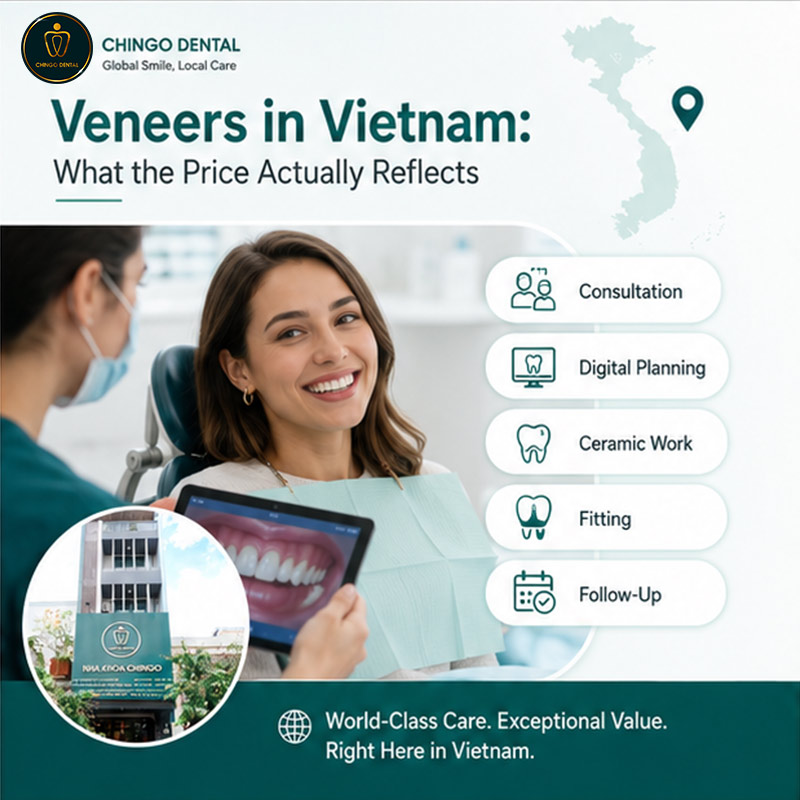
Veneers in Vietnam: what the price actually reflects
Vietnam has quietly become one of the most credible destinations for cosmetic dentistry in Asia. The question most international patients ask is fair: if the cost is this much lower, what’s the catch?
The short answer is that there often isn’t one provided you choose carefully.
The lower porcelain veneers price in Vietnam reflects economic reality, not clinical compromise. Dentists trained at top Vietnamese universities. Many of whom have also completed postgraduate work in Japan, South Korea, Europe, or the US earn Vietnamese salaries. Labs source the same Emax and Zirconia materials from international suppliers. The gap you see in veneers Vietnam price versus Western pricing is structural, not a quality signal.
That said, “Vietnam” is not a monolith. There are clinics equipped with digital imaging, CAD/CAM fabrication, and internationally trained cosmetic specialists. And there are clinics that are not. Vietnam dentist prices varying this widely is itself useful information. IT tells you to look beyond the number and ask about the process.
When evaluating any clinic for veneers, the questions that matter most are these: Does the clinic use Digital Smile Design or a comparable previsualization process? What specific ceramic materials do they offer? Do they have in-house imaging, including 3D cone beam CT? Are there English-speaking staff if you need them? And is the pricing transparent upfront, without surprise add-ons at the treatment stage?
Chingo Dental, with clinics in Hanoi and Da Nang, consistently meets these criteria. Their workflow includes Digital Smile Design, CAD/CAM fabrication, and Emax and Zirconia materials sourced to the same standards used in premium clinics internationally. Bilingual staff handle consultations fully in English, and pricing is published clearly. Something that matters enormously to international patients who don’t want ambiguity about what they’re agreeing to. For expats and medical tourists considering cosmetic dentistry in Hanoi or dentistry in Da Nang, these are meaningful differentiators.
Porcelain veneers vs. Teeth whitening vs. Dental crowns – which is right for you?
Cost comparisons only make sense when you’re comparing treatments that address the same problem. These three options are frequently confused, so it’s worth being specific about what each one does.
Teeth whitening removes surface and subsurface staining from natural tooth enamel. It works well for patients whose teeth are basically healthy and well-shaped, but whose color has shifted over time from coffee, tea, wine, or aging. It doesn’t change tooth shape, correct chips, or fix alignment. In Vietnam, professional whitening typically costs between $80 and $200. Patients searching for teeth whitening in HCMC or other major cities will find plenty of options at this price range. How much is teeth whitening in Vietnam compared to veneers? Significantly less but it’s solving a different problem.
Porcelain veneers change both color and shape, permanently. They’re for patients who want a complete cosmetic transformation. Not just brighter, but also straighter-looking, better-proportioned, more symmetrical. They last 10 to 20 years with proper care, far outlasting whitening results. Teeth whitening price may be lower upfront, but for patients with multiple cosmetic concerns, veneers often provide better long-term value.
Dental crowns cover the entire tooth rather than just the front surface. They’re used when a tooth is structurally damaged heavily filled, cracked, or root canal treated and needs protection as much as cosmetic improvement. Dental crown cost in Vietnam typically ranges from $200 to $600 per tooth, depending on material. If your teeth are healthy and your concern is purely visual, a crown is almost certainly more than you need.
Treatment
Best For
Vietnam Cost Range
Expected Longevity
Teeth whitening
Surface or light staining
$80 – $200
1 – 3 years
Porcelain veneers
Color, shape, gaps, chips
$150 – $450 per tooth
10 – 20 years
Dental crowns
Damaged or structurally weak teeth
$200 – $600 per tooth
15 – 25 years
The right starting point is always a consultation not a price comparison. A dentist who examines your teeth and listens to your goals can tell you which treatment actually fits your situation. Cosmetic teeth goals that sound like a whitening job sometimes turn out to need veneers. And what looks like a veneer case occasionally calls for a crown. Getting that diagnosis right saves money and time.
Is it safe to get porcelain veneers abroad?
For most patients considering cosmetic dentistry in Vietnam, the question isn’t really about safety in the abstract. It’s about specifics: Will the materials hold up? What happens if something goes wrong after I leave? How do I know the work is being done properly?
These are legitimate questions, and they deserve direct answers.
Material traceability matters. Reputable clinics use ceramic from named international suppliers and can tell you exactly what’s going into your veneers. If a clinic is vague about materials or offers prices that seem too low to use quality ceramics, that’s a reason to probe further.
Diagnostic rigor is the clearest quality signal. A clinic that includes a 3D cone beam CT scan as part of their standard workup rather than skipping it or charging it separately to discourage patients is operating to a different standard than one that doesn’t. The scan gives your dentist a precise view of tooth structure, bone density, and root anatomy before any preparation begins. This is not optional for responsible veneer work.
Sterilization and infection control standards vary by clinic, not by country. Asking about sterilization protocols is always reasonable, and a confident clinic will be happy to show you their procedures.
On follow-up care: if you’re traveling from abroad, it makes sense to plan for a second visit if possible, or at minimum to communicate clearly about aftercare before you leave. Quality clinics that work with international patients regularly have protocols for this they’re used to coordinating follow-up with patients’ home dentists and providing detailed documentation of the work completed.
Chingo Dental’s approach to international patients reflects exactly this. Their use of CT Cone Beam 3D imaging, Piezotome-assisted procedures where relevant, and CAD/CAM precision aren’t marketing points. They’re the clinical infrastructure that makes predictable outcomes possible. Patients flying in specifically for veneers represent a meaningful part of their practice, and the workflow reflects that.
Frequently asked questions about porcelain veneers cost (FQA)
Question 1. How much do porcelain veneers cost per tooth on average?
How much are porcelain veneers, and what does each porcelain veneer cost individually? In the United States, most patients pay between $900 and $2,500 per tooth, depending on the material, the clinic, and the dentist’s experience. In Vietnam, the same quality of work using Emax or Zirconia typically runs between $150 and $450 per tooth. The difference comes down to overhead and cost of living, not the quality of materials or craftsmanship.
Question 2. What does a full mouth of porcelain veneers cost?
Most patients treating their full smile focus on 8 to 10 upper front teeth. In the US, that ranges from roughly $9,000 to $25,000 depending on material and number of teeth. In Vietnam, the same porcelain veneers cost full mouth typically falls between $1,500 and $4,500. This is the primary reason many international patients choose to combine a trip to Vietnam with their dental treatment.
Question 3. Are porcelain veneers covered by dental insurance?
In most cases, no. Porcelain veneers are classified as a cosmetic procedure, which puts them outside the scope of standard dental insurance coverage. There are limited exceptions if a veneer is replacing a damaged tooth where the cosmetic and functional goals overlap. But patients should generally plan to pay out of pocket.
Question 4. How long do porcelain veneers last?
With good care, porcelain veneers typically last between 10 and 20 years. Emax and Zirconia veneers tend to perform well at the longer end of that range. Regular dental check-ups, avoiding habits like nail-biting or chewing ice, and wearing a night guard if you grind your teeth all extend the life of your veneers considerably.
Question 5. What is the cheapest type of veneer, and is it worth it?
Composite resin veneers are the most affordable option and can often be done in a single appointment. However, they stain more easily, chip more readily, and typically need replacing within 5 to 7 years. For patients who want long-term cosmetic results, porcelain veneers tend to offer better value over time even though the upfront cost is higher.
Question 6. How does teeth whitening cost compare to veneers in Vietnam?
Professional teeth whitening in Vietnam usually costs between $80 and $200 a fraction of what veneers cost. But the two treatments aren’t interchangeable. Whitening improves color on otherwise healthy, well-shaped teeth. Veneers address color plus shape, size, and surface texture. If you have multiple concerns, veneers almost always provide a more complete result.
Question 7. Is Chingo Dental a reliable option for porcelain veneers?
Chingo Dental operates clinics in Hanoi and Da Nang and works regularly with international patients seeking cosmetic dental treatment in Vietnam. They offer Digital Smile Design consultations, Emax and Zirconia veneer options, in-house CAD/CAM fabrication, 3D cone beam CT imaging, and bilingual staff. Pricing is published transparently, which is particularly valued by patients coming from abroad who are comparing options before committing to travel.
Ready to find out your exact porcelain veneers cost?
The number that actually matters for you isn’t the average it’s the treatment plan designed around your specific teeth, your goals, and the material that fits your bite.
Chingo Dental offers consultations at their Hanoi and Da Nang clinics for patients who want to understand exactly what their smile transformation would involve and what it would porcelain veneers cost. There’s no obligation and no vague pricing. You’ll leave the consultation knowing what’s recommended, why, and what the porcelain veneers price looks like for your case specifically.
If you’re planning a trip to Vietnam and want to make the most of your time here or if you’re already based in the country and have been putting off cosmetic dentistry this is a practical place to start.
Reach out to Chingo Dental to book your smile assessment. English consultations are available at both locations.
Contact Information – Chingo Dental International Cosmetic Dentistry
Chingo Hanoi Branch:
Address: No. 1, Lane 558 Nguyen Van Cu Street, Bo De Ward, Hanoi City
Opening hours: 8:00 AM – 8:00 PM, all days of the week
Email: info@chingodental.vn
Website: https://chingodental.vn
This article is intended for informational purposes. Individual treatment plans and costs vary based on clinical assessment. Consult a qualified dental professional before making any treatment decisions.