If you’ve been searching for a way to fix discolored, chipped, or uneven teeth without crowns, without a full round of braces, and without a result that looks obviously “done”, emax porcelain veneers are likely the answer you’re looking for.
This guide walks you through everything what emax veneers actually are, how they compare to other materials, who they’re best suited for, what the procedure feels like, how long they last, and what they cost. You’ll also find out what to look for in a cosmetic dentistry clinic and why patients traveling to Hanoi and Da Nang are increasingly choosing Chingo Dental for this treatment.
Quick summary:
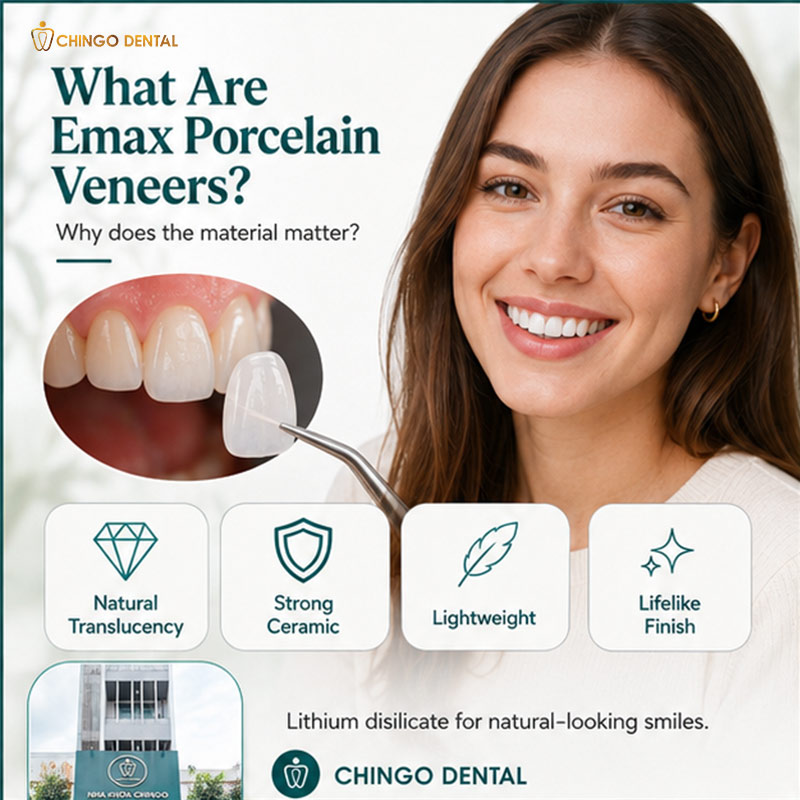
Emax porcelain veneers are ultra-thin ceramic shells bonded to the front of your teeth, designed to look and feel completely natural
They are stronger than traditional porcelain veneers and require less tooth removal
Results typically last 10 – 15 years with proper care
Vietnam offers this treatment at a fraction of the cost compared to the US, UK, or Australia without compromising on materials or technology
What are emax porcelain veneers and why does the material matter?
Not all porcelain veneers are made equal. The term “porcelain” covers a family of ceramic materials, and the differences between them matter far more than most people realize before booking a consultation.
Emax porcelain veneers are made from lithium disilicate ceramic – a glass-ceramic compound developed by Ivoclar Vivadent, one of the most respected names in dental materials globally. What makes this material special is a combination that’s surprisingly rare in dentistry: exceptional strength and exceptional translucency at the same time.
Most restorative materials make a trade-off. Stronger materials tend to look more opaque and artificial. More translucent materials tend to be more fragile. Lithium disilicate dental veneers break that pattern. They can be crafted as thin as 0.3 millimeters while maintaining a flexural strength of 400 to 500 MPa, slightly above the strength of natural tooth enamel, which sits around 380 MPa. That means they don’t just look like real teeth. They hold up like real teeth too.
This is why emax has become the default material for smile makeovers worldwide. When cosmetic dentists talk about the gold standard for anterior restorations. The front teeth that define your smile, they’re almost always talking about lithium disilicate glass-ceramic veneers.
There are two fabrication methods. IPS e.max Press involves pressing the ceramic into a mold under high heat, which produces excellent density and color consistency. IPS e.max CAD uses a computer-guided milling machine to carve the veneer from a solid ceramic block. A faster method that works well for straightforward cases. Your dentist will recommend the right method based on your specific needs and how complex your case is.
How are emax veneers different from traditional porcelain?
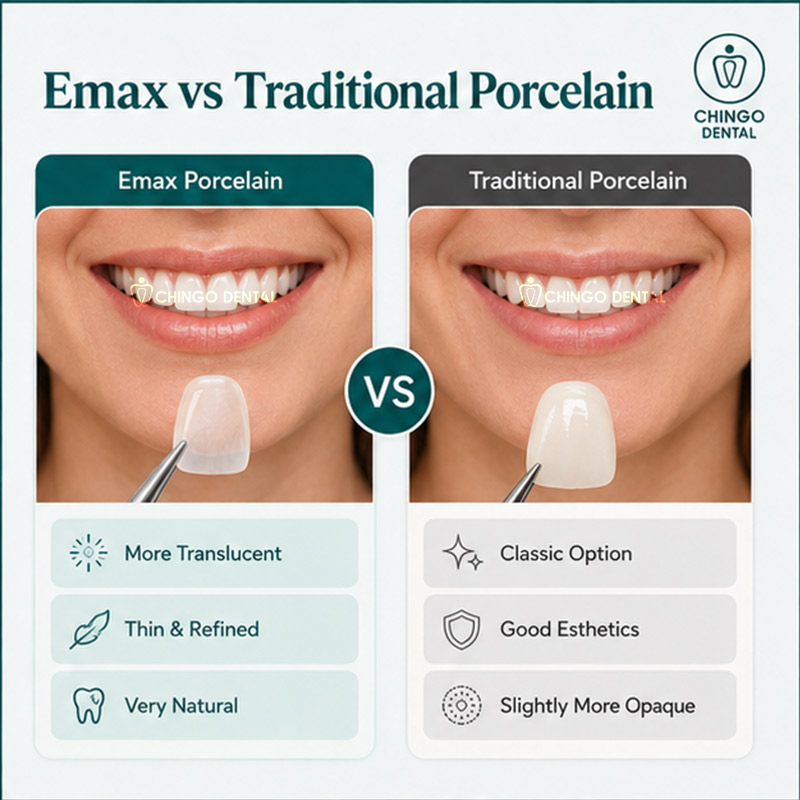
If you’ve researched veneers before, you’ve likely come across feldspathic porcelain, the material that dominated cosmetic dentistry for decades. It’s still used today, and for very specific cases, it’s genuinely the better choice. But understanding the difference helps you ask the right questions at your consultation.
Traditional feldspathic porcelain has extraordinary translucency. When a skilled ceramist layers it by hand, the result can look almost impossibly lifelike. The challenge is that it’s also comparatively fragile, with a flexural strength around 100 MPa, less than a quarter of what emax achieves. That means traditional porcelain veneers require slightly thicker fabrication, which in turn means slightly more enamel removal to accommodate them.
Emax veneers, by contrast, can be made much thinner because the material itself is stronger. Less tooth structure needs to be removed during preparation. For most patients, that’s a meaningful advantage both for comfort and for preserving as much of the natural tooth as possible.
Where feldspathic porcelain still leads is in ultra-translucent, ultra-thin cosmetic cases where maximum cosmetic precision is the single priority. For patients with naturally very translucent teeth and minimal corrections needed, a highly skilled ceramist working with feldspathic porcelain can produce results that emax simply can’t replicate. But these cases are relatively rare. For the vast majority of patients seeking a smile makeover correcting discoloration, chips, gaps, or uneven shapes. Emax porcelain veneers offer the better combination of aesthetics, durability, and tooth preservation.
Emax vs. Zirconia veneers: which one should you choose?
This is one of the most common questions patients ask before committing to treatment, and the honest answer is it depends on your specific teeth and bite.
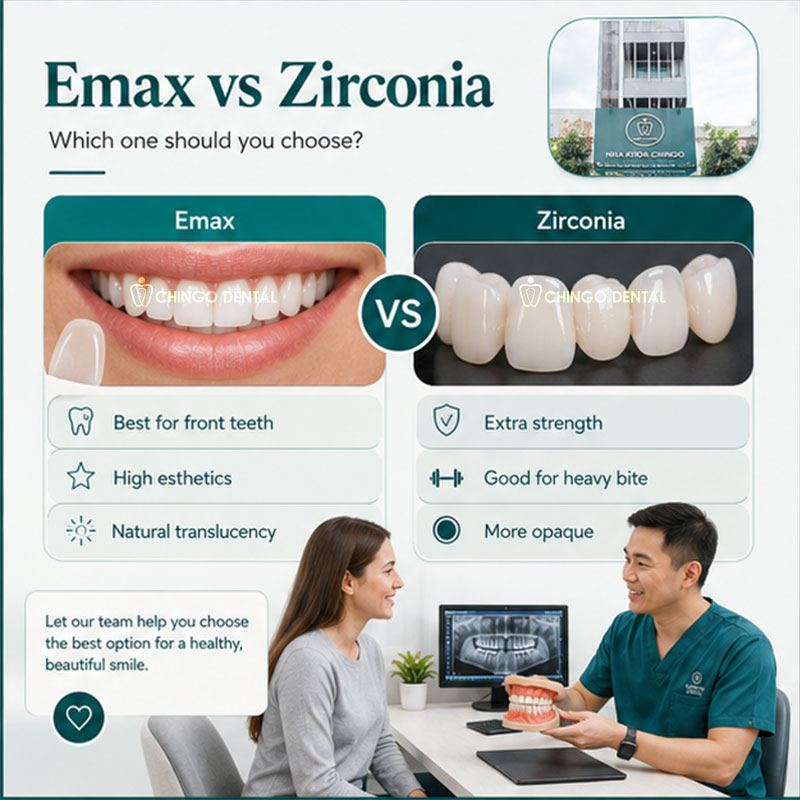
Zirconia is the strongest ceramic material used in dentistry today, with a flexural strength exceeding 1,000 MPa. That makes it virtually unbreakable under normal biting forces, an important consideration for patients who grind their teeth or have a particularly heavy bite. It’s also the standard choice for back teeth, where function matters more than subtlety.
The issue with zirconia for front teeth has historically been its opacity. Traditional zirconia looks bright and white but lacks the natural depth and light transmission that real enamel has. Newer high-translucency zirconia formulations have improved significantly, but for front teeth visible when you smile. Where the goal is to look completely natural emax still leads.
Emax’s glass-ceramic composition allows light to pass through the material in much the same way it passes through natural enamel. Light enters the veneer, reflects off the underlying tooth structure, and exits with the same warmth and three-dimensional quality you see in real teeth. That’s the effect composite resin and standard zirconia simply cannot replicate.
So who should consider zirconia instead? Patients with a confirmed bruxism habit, those needing veneers on multiple upper and lower teeth under significant bite stress, or those whose dentist identifies high fracture risk based on how the teeth meet. In those cases, the strength advantage outweighs the aesthetic difference. A good cosmetic dentistry clinic will assess your bite carefully before recommending one material over the other. Both emax and zirconia veneers are available at Chingo Dental, and the recommendation is always based on your clinical picture not on what’s more convenient to offer.
Who is a good candidate for emax porcelain veneers?
One of the most useful things to understand before a consultation is which problems emax veneers are genuinely designed to solve and which they’re not the right tool for.
Emax porcelain veneers work particularly well for people who have stubborn tooth discoloration that professional whitening can’t fix. Intrinsic staining the kind caused by tetracycline antibiotics, fluorosis, or natural developmental variation sits inside the tooth structure itself. Whitening strips and even in-chair whitening treatments cannot reach it. A ceramic veneer, placed over the front surface of the tooth, covers that discoloration completely and permanently.
Chipped or worn tooth edges respond well to emax veneers too. Many adults develop small chips over time from biting hard foods, minor accidents, or simply years of use. A veneer restores the original shape of the tooth and protects the edge from further wear.
Gaps between teeth, minor misalignment, and teeth that appear too short or too small are also within the scope of what emax veneers can address. They can’t move teeth the way braces do, but by adjusting the shape and proportion of each tooth individually, a skilled dentist can create the visual impression of a straighter, more balanced smile.
There are situations where veneers are not the right starting point. Patients with active gum disease or untreated decay need to resolve those issues first. Veneers placed over unhealthy foundations won’t last, and more importantly, they can mask problems that worsen over time. Patients with severe bruxism may need a night guard or another approach before veneers are considered. And cases with significant misalignment teeth that are rotated or substantially crowded may benefit more from orthodontic treatment first.
A good consultation goes through all of this before anything is planned. If you’re not sure whether you’re a suitable candidate, the honest answer is that you need to be assessed in person. What you can do beforehand is make a clear list of what bothers you about your smile that helps any dentist understand what you’re actually trying to achieve.
What does the emax veneer procedure actually feel like?
A lot of the anxiety around dental veneers comes from not knowing what to expect. Here’s what a well-run emax treatment process looks like from start to finish specifically the approach used at Chingo Dental.
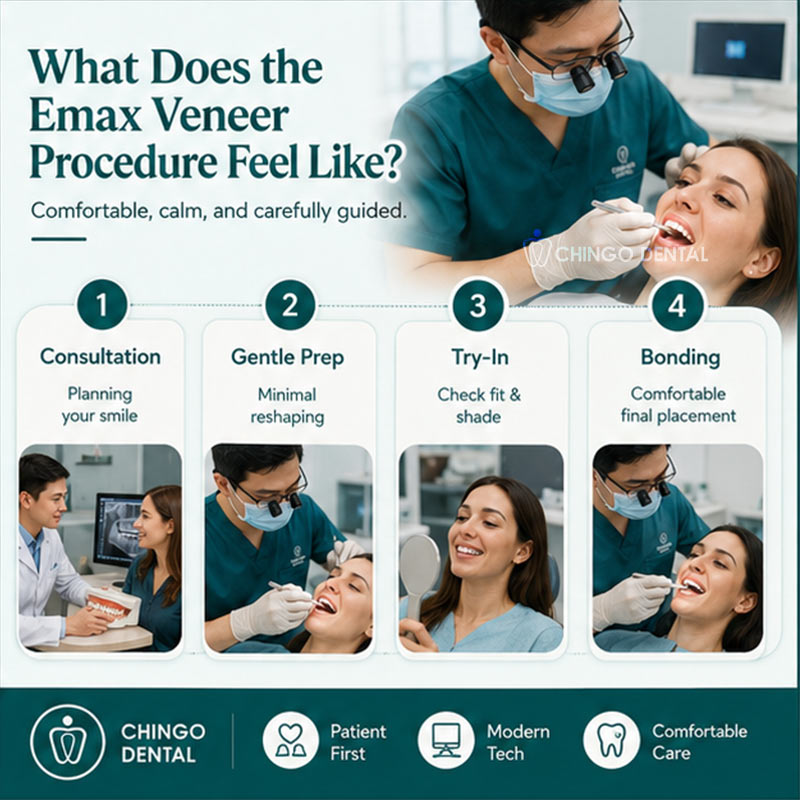
The consultation and smile design session is where the clinical work begins. Your dentist examines your teeth, gums, and bite, takes photographs and digital scans, and discusses your goals. At Chingo Dental, this is also when Digital Smile Design (DSD) comes in. DSD software maps your proposed new smile onto photographs of your actual face, so you can see a realistic preview of what your veneers will look like before any tooth is touched. It removes a lot of guesswork and, for most patients, a lot of anxiety.
Tooth preparation is usually the step patients worry about most. In reality, it is straightforward. Local anesthesia is administered, and the dentist removes a thin layer of enamel from the front of each tooth being treated typically between 0.3 and 0.5 millimeters. Because emax veneers can be made very thin, less enamel is removed than with older veneer materials or crowns. Temporary veneers are placed the same day so you leave the appointment with a full smile while your permanent veneers are being made.
Digital impressions and lab fabrication follow next. Chingo Dental uses a CAD/CAM workflow, a digital scan rather than traditional putty impressions which gives the dental laboratory a precise, accurate model to work from. The emax veneers themselves are fabricated over approximately one to two weeks.
The bonding appointment is usually the most straightforward. The temporary veneers come off, the permanent emax veneers are placed without cement first so you can evaluate the shape, shade, and fit. Any minor adjustments are made at this stage. Once you and your dentist are satisfied, the tooth surfaces are prepared and the veneers are bonded permanently with a resin cement and cured with a dental light. The bite is checked and polished.
Most patients are genuinely surprised by how little discomfort is involved. There may be mild sensitivity for a day or two after preparation particularly to temperature but this settles quickly. By the time the final veneers are placed, most patients say the result exceeded what they imagined from the preview.
How long do emax porcelain veneers last?
Longevity is one of the strongest arguments for choosing emax over cheaper alternatives. A systematic review published in the International Journal of Prosthodontics and Restorative Dentistry reported a clinical survival rate of 98.3% for lithium disilicate veneers at ten years. A more recent study confirmed survival rates between 89% and 94% at fifteen years.
In practical terms: emax porcelain veneers last between 10 and 15 years for most patients, with many lasting longer under good conditions. They are not permanent, no dental restoration is but they are among the most durable cosmetic dental restorations available.
One thing that surprises patients is how resistant emax veneers are to staining. Because the ceramic is non-porous, coffee, tea, wine, and other common culprits don’t penetrate the surface. The veneers maintain their color across their entire lifespan. This is a significant advantage over composite resin restorations, which absorb pigment over time and typically require replacement or touch-ups within five to seven years.
Chipping is possible but uncommon when veneers are placed correctly and the patient follows reasonable care guidelines. Emax is two to three times stronger than traditional feldspathic porcelain, which means it handles everyday biting forces well. Where problems occur, they’re usually linked to biting very hard objects directly, ice, hard candy, fingernails or to unmanaged grinding.
Taking care of emax veneers is simple. Brush twice daily with a non-abrasive toothpaste, floss regularly, and attend professional cleanings every six months. If there’s any tendency to grind teeth, a custom night guard makes a meaningful difference to how long the veneers last. These are the same habits that support overall dental health, there’s nothing extreme or complicated about maintaining emax veneers.
What do emax porcelain veneers cost in Vietnam?
Porcelain veneers cost is one of the most practical questions in this whole decision, and the numbers vary significantly depending on where you are in the world.
In the United States, emax porcelain veneers typically cost between $1,500 and $2,500 per tooth. In the United Kingdom, the range is roughly £800 to £1,500. In Australia, expect to pay $1,800 to $2,500 AUD per tooth. A full smile makeover commonly eight to ten veneers on the upper front teeth represents a significant investment in any of those markets.
Vietnam has become a respected destination for cosmetic dentistry precisely because that investment looks very different here. The materials used are identical certified IPS e.max from Ivoclar Vivadent, the same product used in European and American clinics. The technology CAD/CAM fabrication, digital impressions, Digital Smile Design is the same. What’s different is the cost structure of running a clinic in Vietnam, which makes premium cosmetic dentistry accessible at a fraction of Western prices.
At Chingo Dental, pricing is fully itemized and disclosed at the consultation stage. There are no hidden fees and no consultation charges that then get absorbed into treatment costs. Patients know exactly what they’re committing to before anything begins.
When you calculate the cost across the lifespan of the veneers, the value case becomes even clearer. Fifteen years of emax veneers at Vietnamese pricing often costs less in total than repeated rounds of professional whitening treatments and composite veneer touch-ups over the same period. The upfront cost is real, but so is the durability.
For international patients, both dentistry in Da Nang and dentistry in Hanoi offer practical advantages beyond price. Da Nang is a coastal city that makes a natural base for dental tourism clinics are centrally located, the city is easy to navigate, and recovery time between appointments aligns well with a short trip. Hanoi offers a richer cultural experience for those who want to combine treatment with time exploring Vietnam’s capital.
Why Chingo Dental for emax porcelain veneers?
Choosing a clinic for emax porcelain veneers is not just about price. The material is consistent what varies is the skill and technology behind placement.
Chingo Dental is a cosmetic dentistry clinic with locations in Hanoi and Da Nang, built around a patient experience that international visitors expats and dental tourists consistently describe as genuinely different from what they expected.
The clinic uses only certified IPS e.max materials not generic lithium disilicate alternatives that may carry the same name but lack consistent quality control. Every veneer case begins with a Digital Smile Design session, which means patients see a realistic preview of their result before any clinical work begins. The CAD/CAM fabrication workflow produces precise restorations with minimal margin for error.
The clinical team is English-speaking throughout. This is more significant than it sounds. Cosmetic dentistry requires clear communication about aesthetic preferences shade, shape, length, proportion and those conversations are genuinely difficult when they happen through translation. At Chingo Dental, patients can describe exactly what they want, ask questions at every stage, and receive answers they actually understand.
Both locations are equipped with Cone Beam 3D CT imaging for accurate diagnostics and Piezotome ultrasonic technology for any preparatory procedures. The standard of care is consistent across both clinics, which matters for patients who split their time between Hanoi and Da Nang or who are planning follow-up visits.
Aftercare is built into the treatment plan, not offered as an add-on. Follow-up appointments are scheduled as part of the process, and patients who return to their home countries can access remote consultation support if needed.
Frequently asked questions about emax porcelain veneers (FQA)
Question 1. Are emax veneers the same as porcelain veneers?
Emax veneers are a type of porcelain veneer. The word “porcelain” in dentistry covers a range of ceramic materials. Emax specifically refers to IPS e.max, which is made from lithium disilicate a premium glass-ceramic known for combining strength and natural translucency. When a dentist recommends “porcelain veneers,” ask specifically which material will be used. The difference in quality and longevity can be significant.
Question 2. Do emax porcelain veneers look natural?
They look as natural as the skill of the dentist and ceramist allows them to. The material itself transmits and reflects light in a way that closely mimics real enamel, which makes the technical foundation excellent. The final result also depends on shade selection, tooth preparation, and bonding technique. Patients who have had their veneers placed at Chingo Dental frequently describe the result as being indistinguishable from natural teeth in photographs and in person.
Question 3. Is the procedure painful?
Tooth preparation is done under local anesthesia, so patients feel pressure but not pain during the appointment. Some mild temperature sensitivity is normal in the first day or two after preparation this settles on its own. The bonding appointment is typically the most comfortable stage of the process. Patients who described themselves as anxious about dental treatment before the procedure consistently report it was much easier than they anticipated.
Question 4. How many veneers do I actually need?
This depends entirely on your smile line the teeth that show when you smile and talk. For most patients, six to ten upper front teeth are treated. Going beyond that boundary can sometimes produce an unnatural transition between veneered and non-veneered teeth. Your dentist will show you exactly which teeth are being considered during the Digital Smile Design session, so you can evaluate and discuss the proposed scope before any decision is made.
Question 5. Can I get emax veneers done in Vietnam as an international patient?
Many international patients from Australia, the UK, the United States, Singapore, and across Southeast Asia choose Chingo Dental specifically for this treatment. The clinic is structured to accommodate visitors, with English-speaking staff, treatment timelines that work within a short trip, and clear communication protocols for follow-up care after patients return home. Dentistry in Hanoi and dentistry in Da Nang at this level of quality and transparency is one of the genuinely underappreciated advantages of Vietnam’s growing cosmetic dental sector.
Question 6. What happens if a veneer chips or comes off years later?
Minor surface chips can sometimes be polished smooth. More significant damage typically requires replacing the individual veneer not the full set. Because each veneer is fabricated individually, one damaged restoration doesn’t affect the others. This is another reason why choosing a clinic that records precise shade and fabrication data matters: a replacement veneer made years later should match the rest of the smile seamlessly.
The right smile is worth getting right
Emax porcelain veneers represent one of the best investments in cosmetic dentistry available today. The material has the clinical evidence behind it, the aesthetic qualities that make a real difference to how a smile looks, and the durability to justify the cost over a 10 to 15-year lifespan.
The decision to proceed is personal. What the research, the clinical data, and the experience of thousands of patients all point to is this: when emax veneers are placed by a skilled cosmetic dentist using quality materials and proper technique, the results are consistently excellent.
If you’re considering this treatment whether you’re based in Vietnam, planning a dental tourism visit, or simply looking for a clinic where you can have a detailed, unhurried conversation about your options Chingo Dental offers free initial consultations at both its Hanoi and Da Nang locations. The Digital Smile Design session means you’ll leave that first appointment with a clear picture of what your smile could look like. No commitment required.
Book your consultation at Chingo Dental today and see your new smile before treatment begins.
Contact Information – Chingo Dental International Cosmetic Dentistry
Chingo Hanoi Branch:
Address: No. 1, Lane 558 Nguyen Van Cu Street, Bo De Ward, Hanoi City
Opening hours: 8:00 AM – 8:00 PM, all days of the week
Email: info@chingodental.vn
Website: https://chingodental.vn
This article is intended for informational purposes. Individual treatment plans and costs vary based on clinical assessment. Consult a qualified dental professional before making any treatment decisions.