


If you’ve ever caught yourself covering your mouth when you laugh, or felt a flash of self-consciousness every time you smile in a photo, you’re not alone. For many people, the problem isn’t crooked teeth or discoloration. Instead, it is often a dark, metallic filling sitting right in plain sight or a small chip on a front tooth that never quite healed right. A cosmetic dental filling can fix both, often in a single appointment, and leave your tooth looking like nothing ever happened.
This guide walks you through everything, including what cosmetic fillings actually are, which material suits your situation, how the procedure feels, how long results last, and what it realistically costs, especially if you’re considering treatment in Vietnam.
Here’s what you’ll find in this article:
- The real difference between a cosmetic filling and a standard one.
- A plain-language breakdown of composite resin, ceramic, and other tooth-colored options.
- Step-by-step procedure overview, aftercare tips, and longevity expectations.
- Honest cost context for getting treatment in Hanoi or Da Nang.
What is a cosmetic dental filling, and is it different from a regular filling?
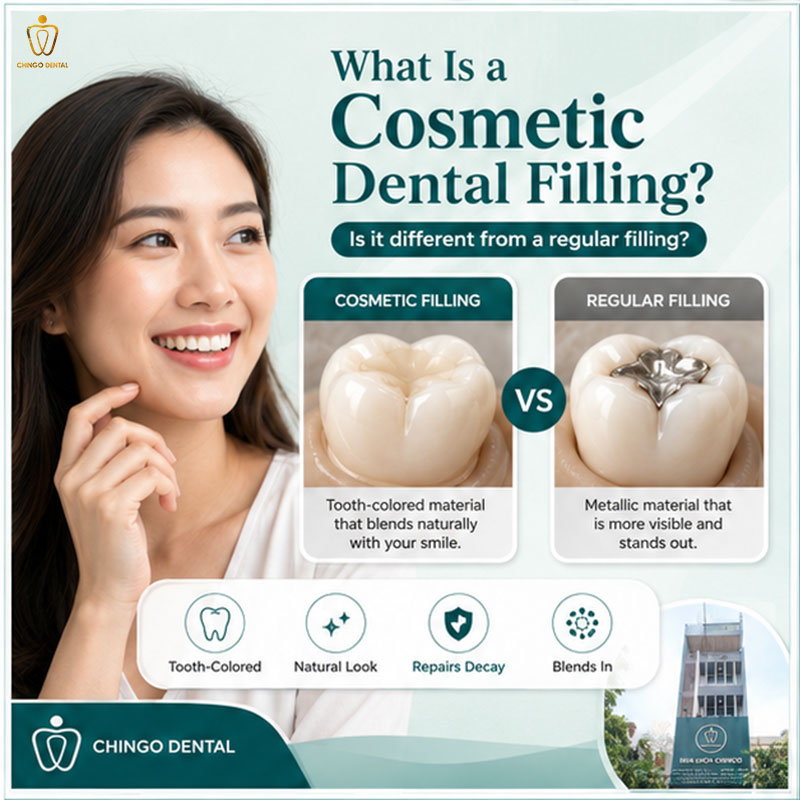
Most people assume all fillings are the same, but they are not. A standard filling is about function. It is designed to seal the cavity, stop the decay, and move on. A cosmetic dental filling does that too, but it also prioritizes how your tooth looks afterward.
The key difference lies in the material. Traditional amalgam fillings use a silver-mercury alloy that’s durable and cost-effective, but visually obvious. A cosmetic filling uses tooth-colored materials, most commonly composite resin or ceramic, that are carefully shade-matched to blend with your natural enamel. When done well, you genuinely cannot tell the filled tooth from its neighbors.
This makes cosmetic fillings the right choice for cavities on front teeth, chipped or fractured enamel, or situations where a patient wants to replace old amalgam restorations for a cleaner, more natural-looking smile. Cosmetic dentistry has made these materials significantly better over the past decade, and the results now rival the aesthetics of more expensive treatments like veneers.
It’s also worth knowing that cosmetic fillings aren’t just about vanity. Tooth-colored composite resin bonds chemically to the tooth surface. This means your dentist can often remove less healthy enamel during preparation, which is a genuine clinical advantage rather than just an aesthetic one.
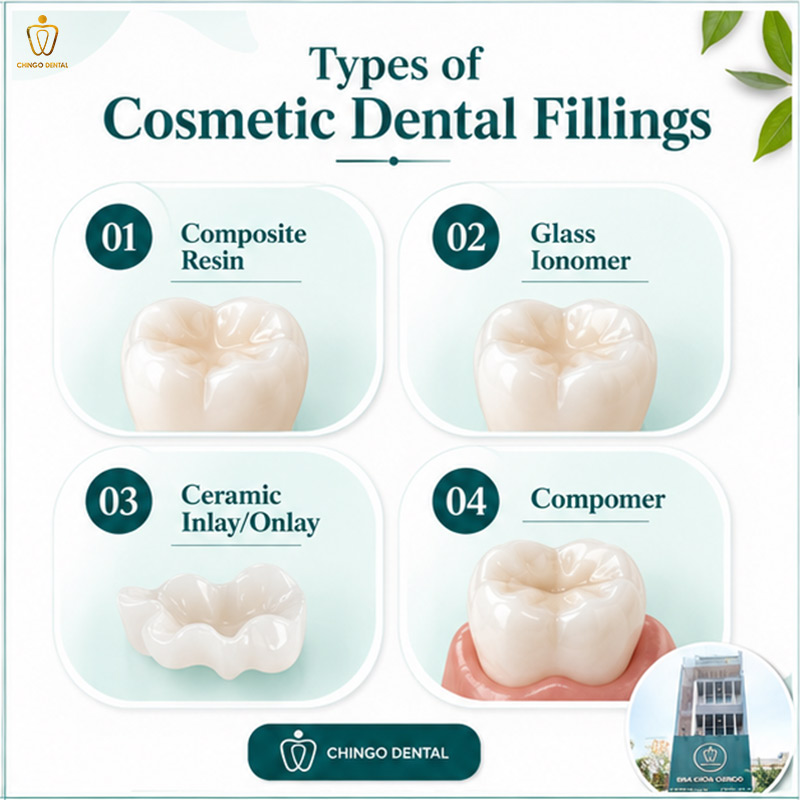
What are the different types of cosmetic dental fillings?
Not every cosmetic filling is made from the same material, and each option has a distinct profile in terms of appearance, durability, and cost. Understanding the differences helps you have a more productive conversation with your dentist before treatment begins.
Composite resin fillings: the everyday workhorse
Composite resin is the most widely used material for tooth-colored fillings. It’s a mixture of fine glass or quartz particles suspended in a plastic resin base. The dentist applies it in soft, pliable layers, sculpts it to match the contour of your tooth, then hardens each layer with a curing light. The final result is a seamless filling that reflects light similarly to natural enamel.
Composite resin works well for small to medium cavities on both front and back teeth. It requires only one appointment, preserves more of the natural tooth structure, and is the most affordable entry point into cosmetic dental care. The trade-off is that composite can absorb stains over time, particularly from coffee, red wine, and tobacco, and it typically lasts between five and ten years before it may need replacement or polishing.
For patients who want a natural-looking filling without committing to a higher budget, composite resin delivers reliable, aesthetically pleasing results.
Ceramic and porcelain fillings: when longevity and precision matter
Ceramic fillings, often in the form of inlays or onlays, represent a step up in both aesthetics and durability. Instead of being placed directly into the tooth, a ceramic restoration is fabricated to precise measurements before being bonded in place. This means the fit is exceptionally accurate, the color stability is far superior to resin, and the material can withstand heavier chewing forces without wearing down.
Porcelain and ceramic don’t absorb stains the way composite resin does. Under proper care, ceramic inlays can last fifteen to twenty years. They’re particularly well-suited for larger cavities on molar teeth or for patients who want the most lifelike and longest-lasting aesthetic restoration available.
The conventional process requires two appointments, including one to prepare and take impressions and another to bond the finished piece. However, clinics equipped with CAD/CAM technology can produce and place ceramic restorations in a single visit. Chingo Dental uses CAD/CAM systems at both its Hanoi and Da Nang locations, which means same-day ceramic fillings are a real option for eligible patients.
Glass ionomer fillings: a supporting role
Glass ionomer is a tooth-colored material, but it’s not primarily chosen for cosmetic purposes. It releases fluoride into the surrounding tooth, which makes it useful for fillings near the gumline, in pediatric dentistry, or as a liner beneath other restorations. Its appearance is acceptable, but it is not as refined as composite or ceramic, and it wears more quickly under chewing pressure. For purely cosmetic outcomes, composite resin and ceramic are consistently the better choices.
How do the main options compare?
The table below gives a practical side-by-side view:
|
Composite Resin |
Ceramic / Porcelain |
Glass Ionomer |
|
|---|---|---|---|
|
Appearance |
Very natural |
Exceptional |
Acceptable |
|
Durability |
5 – 10 years |
10 – 20 years |
3 – 5 years |
|
Stain resistance |
Moderate |
High |
Low |
|
Visits required |
1 |
1–2 (or 1 with CAD/CAM) |
1 |
|
Relative cost |
$ |
$$$ |
$ |
|
Best for |
Front teeth, small-medium cavities |
Larger cavities, premium longevity |
Near-gumline, pediatric cases |
Cosmetic filling, veneer, bonding, or crown: how do you know which one you need?
This is one of the most common points of confusion for patients researching aesthetic dental treatments. The treatments overlap in what they look like but differ significantly in what they fix and how invasive they are.
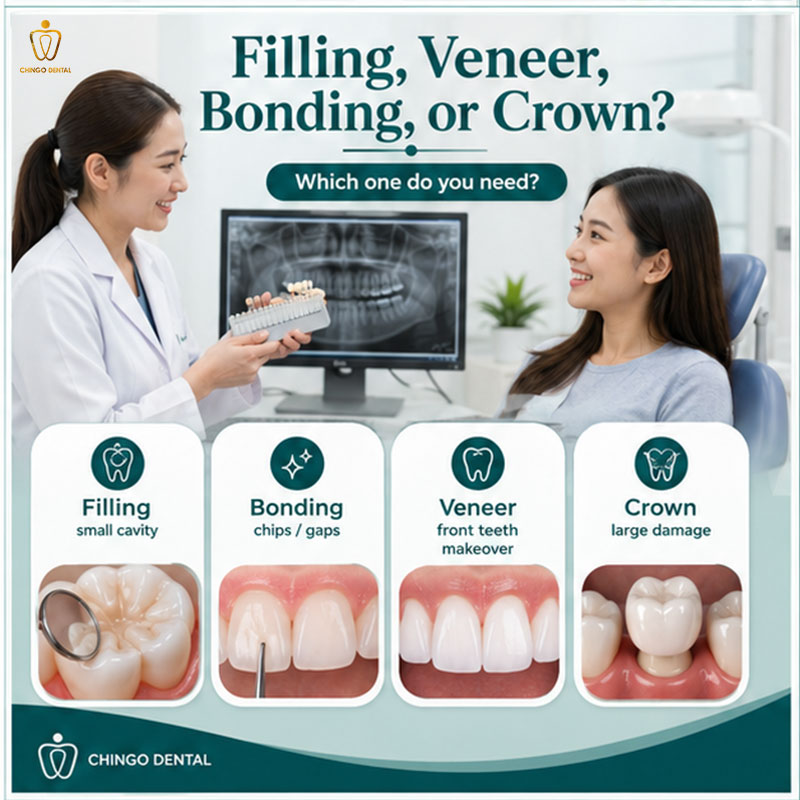
A cosmetic dental filling is the right choice when there is actual decay or structural damage, such as a cavity that needs to be cleaned out, a chipped edge that has exposed the inner tooth, or an old amalgam restoration that needs replacing. The filling repairs the tooth from the inside.
Dental bonding uses the same composite resin material as a white filling, but the application is different. Bonding is applied directly to the outer surface of a structurally sound tooth to close a gap, lengthen a slightly short tooth, or cover a surface-level discoloration. No drilling is required. If your tooth is healthy but you want to improve its shape or color, bonding may be appropriate.
Dental veneers are ultra-thin porcelain shells bonded to the front surface of a tooth. They’re a cosmetic-only solution for teeth that are sound but visually imperfect, such as stained enamel that whitening can’t fix, minor crowding on front teeth, or size inconsistencies across the smile. Veneers require a small amount of enamel removal and represent a longer-term cosmetic commitment.
A dental crown covers the entire visible tooth and is reserved for cases where a tooth is too damaged or weakened to support a conventional filling. Crowns are the most protective option, but also the most invasive in terms of tooth preparation.
What happens during a cosmetic dental filling procedure?
The appointment typically begins with a shade-matching step. Your dentist holds a color guide next to your tooth to select the composite shade that most closely matches your natural enamel. At Chingo Dental, the team uses Digital Smile Design tools to ensure color accuracy, which is particularly important for visible front teeth.
Once the shade is confirmed, the area is numbed with a local anesthetic. The dentist removes any decayed or damaged tissue using a dental drill or a minimally invasive air abrasion tool. Only the affected portion of the tooth is removed, and healthy enamel is preserved wherever possible.
The prepared surface is etched with a mild acid gel to create microscopic ridges that help the composite bond securely to the tooth. A bonding agent is applied, then the composite resin is placed in thin increments. Each layer is hardened with a curing light before the next is applied. After the final layer is cured, the dentist shapes and polishes the material until the surface texture matches the surrounding tooth. The bite is checked carefully and adjusted if needed.
For ceramic inlays made in a dental lab, the process follows a different sequence: a detailed impression is taken at the first visit, a temporary filling is placed, and the custom ceramic piece is bonded at a second appointment.
Composite resin fillings on front teeth, where chewing forces are lighter, routinely last eight to ten years with proper care. On back molars, the same material may show wear closer to the five-to-seven-year mark. Ceramic inlays, by contrast, are significantly more durable and can remain intact for fifteen to twenty years in patients who don’t grind their teeth and attend regular check-ups.
Several factors accelerate wear. Patients who clench or grind put much greater stress on their restorations. Highly pigmented foods and drinks, such as coffee, tea, red wine, and dark curries, stain composite resin progressively over time. Smoking is another factor. Not only does it discolor composite material, but it also slows gum healing and affects the surrounding tooth structure.
How do you take care of a cosmetic dental filling after the procedure?
In the hours immediately after the appointment, the anesthetic will still be wearing off. Avoid chewing on the treated side until sensation fully returns, as it’s easy to bite your cheek or tongue.
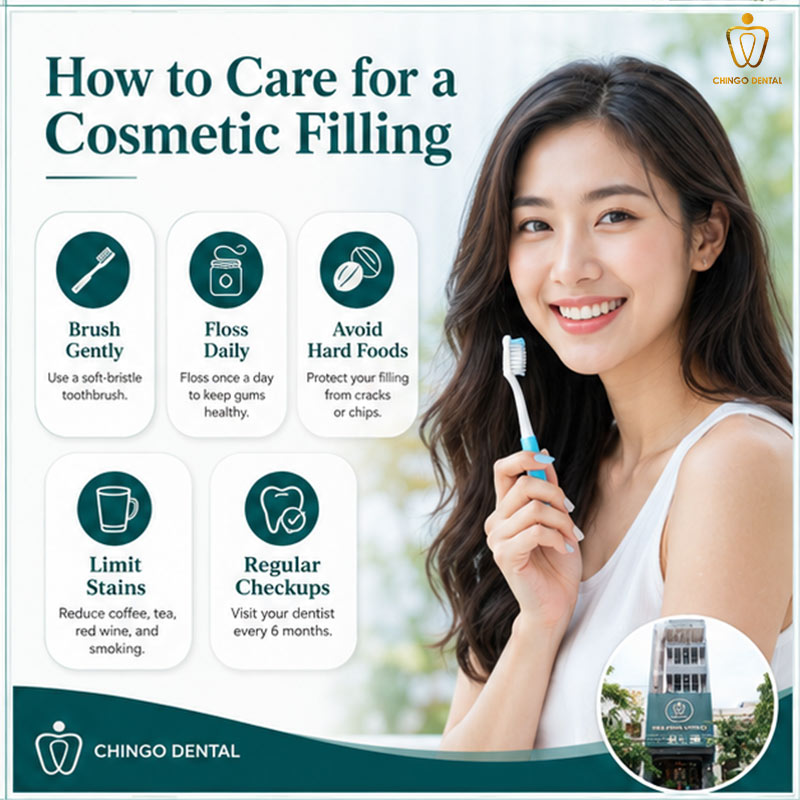
For ongoing composite filling maintenance, the habits that protect natural teeth protect fillings just as well. Brushing twice daily with a soft-bristled brush and a non-abrasive toothpaste keeps the surface from scratching. Abrasive whitening toothpastes, in particular, can dull the polish of composite resin over time. Flossing once daily protects the margins where the filling meets the tooth.
If you drink coffee or red wine regularly, rinsing with water immediately afterward reduces surface staining noticeably. Avoiding tobacco entirely is the single most impactful lifestyle choice for maintaining white filling color.
What does a cosmetic dental filling cost?
In the United States or United Kingdom, a single composite resin filling typically costs between $150 and $300 per tooth. Ceramic inlays run considerably higher, often $800 to $1,500 per tooth depending on the practice and location. These figures reflect both the material cost and the significantly higher overhead of running a dental practice in those markets.
Vietnam offers a very different equation. The cost of high-quality cosmetic dentistry in Hanoi and Da Nang is substantially more accessible without any meaningful compromise on materials, technology, or clinical skill. Many patients who visit Chingo Dental for dentistry in Hanoi or dentistry in Da Nang are expatriates or medical tourists who find that even accounting for travel, the total cost of treatment is a fraction of what they would pay at home.
Cost drivers include the number of tooth surfaces involved, whether the restoration is direct composite or a lab-fabricated ceramic piece, and whether any pre-treatment imaging or Digital Smile Design work is involved. At Chingo Dental, pricing is shared transparently during the initial consultation.
Why do patients choose Chingo Dental for cosmetic fillings in Vietnam?
The clinic uses Digital Smile Design technology for shade selection and treatment planning. For ceramic restorations, CAD/CAM systems at both the Hanoi and Da Nang locations allow same-day fabrication in eligible cases.
For international patients, the bilingual team is a practical advantage. Being able to explain your concerns, understand your options, and ask follow-up questions in English, without anything getting lost in translation, changes the quality of the decision-making process. Patients describe this as one of the most reassuring aspects of choosing Chingo.
Patients who’ve had old silver fillings replaced at Chingo Dental frequently describe the result as “completely natural,” a phrase that says a lot given that the standard for a good cosmetic filling is that it shouldn’t be noticeable at all.
Frequently asked questions about cosmetic dental Fillings (FQA)
Questions 1. Is a cosmetic dental filling the same as a regular filling?
The function is the same because both seal a cavity and restore the tooth. The difference is the material and the priority. A standard filling may use amalgam (silver), which is durable but visible. A cosmetic dental filling uses tooth-colored composite resin or ceramic, chosen to match your natural shade.
Questions 2. Does getting a cosmetic filling hurt?
The procedure is performed under local anesthesia, so the experience is typically pressure without pain. After the anesthetic wears off, some sensitivity to cold drinks or biting pressure is normal for one to two days.
Questions 3. Can I replace my old silver amalgam fillings with a cosmetic alternative?
Yes. Replacing amalgam with composite resin or ceramic is one of the most common cosmetic dental requests. The old filling is removed, the tooth is cleaned, and a shade-matched tooth-colored filling is placed in its position.
Questions 4. How do I know whether I need a filling or a veneer?
If your tooth has a cavity, a chip that has compromised the enamel, or an old filling that needs replacing, a cosmetic filling is the clinically appropriate solution. Veneers are for teeth that are structurally sound but cosmetically imperfect.
The bottom line
A cosmetic dental filling is one of the most accessible, least invasive ways to improve how your smile looks. Whether you’re repairing a cavity on a visible tooth, replacing an old silver filling, or fixing a small chip, a tooth-colored composite or ceramic restoration can solve the problem in a single appointment and leave your tooth looking completely natural.
Composite resin is the practical, affordable option for most cases. Ceramic delivers superior longevity and stain resistance for patients willing to invest more. If you’re in Vietnam, the combination of high-quality cosmetic dentistry and significantly more accessible pricing makes Chingo Dental worth a conversation.
Contact Information – Chingo Dental International Cosmetic Dentistry
Chingo Hanoi Branch:
- Address: No. 1, Lane 558 Nguyen Van Cu Street, Bo De Ward, Hanoi City
- Hotline: 0915.217.855 – 0912.391.909 – 0978.090.780
Chingo Da Nang Branch:
- Address: No. 22 Le Hong Phong Street, Hai Chau Ward, Da Nang City Da Nang
- Hotline: 0916.019.696 – 0919.590.326 – 0916.102.552
Opening hours: 8:00 AM – 8:00 PM, all days of the week
Email: info@chingodental.vn
Website: https://chingodental.vn
This article is intended for informational purposes. Individual treatment plans and costs vary based on clinical assessment. Consult a qualified dental professional before making any treatment decisions.